9/11 as Sequel to Iran-Contra: Armitage, Carlucci and Friends

Dick Cheney and Donald Rumsfeld are among the leading suspects in the crimes of September 11, 2001.  Reasons for this include that they were in the most powerful positions in the U.S. that day, that there is evidence they had foreknowledge of the attacks, and that they did not respond effectively.  Other people who were closely associated with Dick and Don should also be investigated if they were in positions to be involved.  Richard Armitage and Frank Carlucci are two such people.  They both played important roles with respect to the events of September 11, 2001 and, prior to that, both had a colorful history of covert operations which intertwined and was aligned with the careers of Dick and Don.  Armitage and Carlucci both also benefited from the War on Terror by way of profits made after the attacks.

For the twelve years prior to the attacks, Frank Carlucci ran the Carlyle Group, an investment firm with close ties to the most powerful members of the Reagan and Bush I administrations, and to the Saudi Arabian oil industry.  The two major operating subsidiaries of that company were BDM international, for which Carlucci was chairman, and the Vinnell Corporation.  Working for Carlucci at BDM from 1989 to 1996 was its vice president, Barry McDaniel, who left to become the Chief Operating Officer for a an alarmingly suspicious company.  That was Stratesec, the security company that had contracts for so many of the facilities associated with the 9/11 attacks.

On September 11, 2001, Carlucci was meeting with Carlyle investors at the Ritz Carlton Hotel in Washington, DC, along with the brother of Osama bin Laden.[1]  Former president George H.W. Bush had been meeting with them the previous day.  Today, McDaniel is business partners with one of Dick Cheney’s closest former colleagues, Bruce Bradley, whose business partner Alan Woods is mentioned below.[2]

Armitage was one of the signatories of a 1998 letter to President Clinton from the Project for a New American Century (PNAC), calling for military intervention against Saddam Hussein in Iraq.  In 2001, Armitage was the Deputy Secretary of State reporting to Colin Powell.  He was involved in the secure video teleconference run by Richard Clarke that failed to respond to the hijacked airliners.  The week of 9/11, in Washington, Armitage met with General Mahmud Ahmed, the head of Pakistani Inter-Services Intelligence (ISI) who ordered $100,000 to be wired to the alleged hijackers.  Moreover, Armitage was a director at Choicepoint, which provided DNA testing on 9/11 victims through its subsidiary, Bode Technology.

At the time of the attacks, Armitage was the boss of Marc Grossman, Undersecretary of State for Political Affairs, and Grant S. Green, Undersecretary of State for Management.  It has been reported that Grossman met with General Ahmed as well, prior to 9/11.[3]  As Undersecretary of Management, Green was responsible for administration of U.S. embassies abroad as well as coordination with the president on key management issues, and he supervised the State Department’s Office of White House Liaison.

Green’s position in the State Department put him in control of the Bureau of Consular Affairs, which issued visas to foreign nationals.  The Bureau’s new express visa program, instituted under the leadership of Armitage and Green, provided visas to five of the alleged 9/11 hijackers.  Ten of the other alleged hijackers had previously received their visas in the same U.S. consulate office in Saudi Arabia.  The express program made an already bad system worse because the new process was one in which “The issuing officer has no idea whether the person applying for the visa is actually the person (listed) in the documents and application.”[4]  That is, in terms of the visas anyone could have taken the place of the alleged hijackers and Armitage and Green were in a position to supervise that dubious process.

Therefore Carlucci, Armitage and Green had interesting connections to 9/11.  Furthermore Green’s background recalls the secret history of Armitage and Carlucci, two men who greatly influenced U.S. government policy in the 25 years before 9/11.

Some History

Frank Carlucci was one of the oldest and closest friends of Donald Rumsfeld, whose role as Secretary of Defense on 9/11 was central to the events of that day.  They were college roommates together at Princeton and Rumsfeld brought Carlucci into his first position in the federal government at the Office of Economic Opportunity (OEO).  Carlucci went on to become Deputy Director of the Nixon Office of Management and Budget (OMB), and was later appointed Ambassador to Portugal by President Ford.

Like Richard Clarke, Robert Gates and Paul Wolfowitz, Carlucci’s career as a powerbroker in the U.S. federal government transcended political affiliation.  That might be due to his charm and ability to work with others, or it might be that he was an operative of deep state organizations which transcended political parties.  His history suggests the latter.

Before joining the Carter Administration as Deputy Director of the CIA in 1977, Carlucci had a long history of being implicated in world-changing covert operations.  According to the London Times, he was “accused of plotting the 1961 assassination of Patrice Lumumba, who won independence for the Congo; the overthrow of Chilean president Salvador Allende; coups in Brazil and Zanzibar; and numerous other covert actions.”[5]

Carlucci denied these accusations and none were proven, but such claims continued.  It was reported that Carlucci “was also accused by Italian communists of being behind the kidnapping of Aldo Moro, and subverting the revolutionary process in Portugal.”  In Central America, the spokesman for the Sandinista Front in Nicaragua told reporters that Carlucci “has been a specialist in dirty work and coup attempts in the Third World.”[6]

Carlucci was also “very close friends” with Ted Shackley, a man who was at the center of a private network of covert operatives created after the U.S. government began to cut back CIA activities in the mid-1970s.[7]  Shackley and his associate Thomas Clines knew Carlucci from the 1973 U.S-led coup in Chile, for which Carlucci arranged funding via his role in the OMB.  It was Shackley, with help from George H.W. Bush, who maneuvered Carlucci into the position of Deputy Director of the CIA.

Shackley had a long, close working relationship with Richard Armitage as well.  While Carlucci was working in the Nixon Administration and later in Portugal, Shackley and Armitage were funding covert operations from Southeast Asia by way of drug trafficking.  Vast amounts of cash were smuggled out of Vietnam via this operation, along with military armaments, by Clines and another associate, Richard Secord.[8]

In 1975, Secord was transferred to Iran as chief of the Air Force’s Military Advisory Assistance Group (MAAG). With Shackley, Clines and others, Secord established an arms sales company called Egyptian American Transport and Service Corporation (EATSCO). Later EATSCO was convicted of embezzling millions of dollars from the Pentagon.  In the mid-1980s, Secord worked for The Vinnell Corporation, a fact which surfaced during the Iran-Contra investigations.[9]

Another person referred to as a “silent partner” in EATSCO was Erich Von Marbod, who later became Carlucci’s special assistant at a company called Sears World Trade (SWT).  Von Marbod was also the long-time mentor of Richard Armitage, having supervised him in operations in Vietnam and Iran.  In Sept 1975, when Secord was relocated there, Von Marbod went to Tehran as the personal representative of Defense Secretary James Schlesinger.  Armitage followed with his own “entourage.”[10]

In 1979, as the Shah was falling, Von Marbod negotiated (or extorted) a memorandum of understanding from the Iranian government which  essentially gave power of attorney to the United States government to terminate all of Iran’s military contracts.  The document put Iran in a difficult situation with respect to armaments just as it was facing a potential war with Iraq.[11]

Unofficial U.S. aid to the Mujahideen in Afghanistan also began in the summer of 1979.  Proxy agents coordinated by the Safari Club had been invading Afghanistan for about a year prior to that.  The U.S. aid to the Mujahideen, a rebel group from which al Qaeda originated, officially did not start until 1980 but went on for many years under the name Operation Cyclone.  This operation relied heavily on using the Pakistani Inter-Services Intelligence (ISI) as an intermediary for funds distribution, passing of weapons, military training and financial support.

With help from the CIA, the ISI armed and trained over 100,000 insurgents between 1978 and 1992.[12]  That is, the Mujahideen, and therefore ultimately al Qaeda, was armed and trained by the U.S. and the ISI during the time when Frank Carlucci was working as Deputy Director of the CIA, leading the Department of Defense, and acting as CEO of SWT, which was discovered to be an arms sales consultant firm.  During this time, Armitage was a major driver of this policy, traveling to Pakistan and Afghanistan and even meeting directly with Mujahideen leaders.[13]

In 1980, Secord helped plan the efforts to rescue the U.S. hostages held in Iran and some have expressed suspicions that he and Oliver North sabotaged the final operation for political purposes.  Coincidentally, David Rubenstein, the founder of The Carlyle Group, had access to the secret plan for what turned out to be the failed rescue attempt when he was “shuffling through some papers in the president’s inbox.”  Rubenstein was actually in the president’s office by himself one night, supposedly looking for a memo.  Dan Briody wrote that “President Carter questioned Rubenstein about his late-night foray into his office, asking him pointedly and repeatedly what he had seen while he was there.”[14]

The rescue operation appears to have failed through a hard to believe sequence of mechanical problems with the helicopters.  It was a challenging plan but it never really got off the ground at all.[15]  Initially, one of six helicopters failed due to rotor blade malfunction, then a second failed in a sandstorm (the common notion is that all of them failed in this way), then a third helicopter failed by way of a faulty hydraulic pump.  Finally, a ground-based refueling accident resulted in the deaths of nine people.  It was at this time that “Carter’s presidency did not recover.”[16]

Sears World Trade

Considering the Kuwaiti links of Stratesec CEO Wirt D. Walker III, including his leadership of Stratesec’s Kuwaiti-based parent company starting in 1982,[17] it is interesting that Ted Shackley also began working in Kuwait in the early 1980s. It was George H.W. Bush, whose family has many ties to Walker, who helped Shackley get established in Kuwait in the oil business.[18]

Back in the U.S. at this time, Frank Carlucci was one of the most powerful people in government.  He was Deputy Secretary of Defense from 1981 through 1982, while Armitage served as Deputy Assistant Secretary and then Assistant Secretary.  Despite having this important job, Carlucci left government to run the mysterious SWT for a few years at the height of his government career.  After SWT lost tens of millions of dollars in apparently aimless endeavors, Carlucci returned to be Reagan’s National Security Advisor (NSA), and then his Secretary of Defense.

Just before leaving his position as Deputy Secretary of Defense, in 1982, Carlucci did a favor for Secord.  After being suspended from his DOD job for three months while he was being investigated by the FBI about his links to EATSCO, Secord was reinstated by CarlucciSecord retired a year later and established Stanford Technology Trading Group International, which used “a complex web of secret Swiss bank accounts and shell corporations “to build “a lucrative Enterprise from covert-operations business assigned to them by Lt. Col. Oliver L. North.”[19]
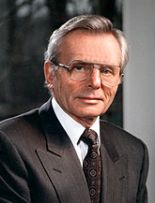
It was at this time that Carlucci left his DOD post for SWT, a company which was ostensibly designed to replicate a Japanese-style trading company.  Through review of the company’s operations, however, Fortune Magazine suggested that SWT was actually “providing cover jobs for US intelligence operations.”  The accusation was supported when the Washington Post revealed the existence of a secret SWT subsidiary called IPAC.

Carlucci joined SWT when Roderick M. Hills, former Chairman of the U.S. Securities and Exchange Commission (1975 to 1977), was its chairman.  Hills quickly noticed that he was no longer in charge.  In an interview with author Joseph Trento, Hills remarked that he was — “shocked to see that Carlucci hired Von Marbod when we all knew he was under criminal investigation… When I went down to the Sears World Trade Washington office across from the National Archives, the place looked like spook central. Carlucci was answering to a higher authority, and I don’t think it had anything to do with world trade for profit.”[20]  Hills resigned in April 1984, leaving SWT to Carlucci.

Carlucci hired Von Marbod at a salary of $200,000 per year, or approximately half a million per year in today’s dollars.  The company had 1,100 employees in offices around the world but Von Marbod worked with Carlucci in Washington, DC.  Carlucci hired some other interesting people to run this “spook central” operation.  There was:

  • S. Linn Williams, a Princeton graduate who wasthe Vice President and General Counsel for SWT.  For many years after his stint there, Williams was with Gibson Dunn & Crutcher, the law firm that employed U.S. Customs Commissioner Robert Bonner, who played an important role in the identification of the alleged 9/11 hijackers, and Ted Olson, whose testimony was critical to the official story about Flight 77.[21]
  • Arthur P. Ismay was SWT’s Director of Countertrade.  Countertrade was an important function for SWT and was also critical to Iran’s ability to obtain the arms it needed at the time.  Interestingly, from July 1962 to June 1964 Ismay was the Officer-In-Charge of the presidential yacht USS Sequoia.  President Kennedy held strategy meetings on the Sequoia during the Cuban Missile Crisis, and had his last birthday party on the yacht.  Ismay later said he had information implicating a colleague in the Kennedy assassination.[22]  He was never questioned about it and, instead, he was told to destroy the ship’s logbook.[23]  Ismay went on to become a swift boat commander in Vietnam.  After military service, he worked for Rockwell International, the company that was the predecessor to Stratesec’s sister companies, Aviation General and Commander Aircraft.[24]
  • Alan Woods was Vice President of Technology for SWT from 1983 to 1985. In his book, Dick Cheney mentioned the importance of the firm Bradley Woods to his own career in the 1970s. And as stated before, Stratesec COO Barry McDaniel is now in close business partnership with Woods partner, Bruce Bradley.  Woods had previously served in the Ford DOD as Assistant Secretary for Public Affairs; Special Assistant to the Secretary (Rumsfeld); and as Deputy Director of Presidential Personnel at the White House. After his time with SWT, Woods became a U.S. Trade Representative in the Reagan Administration.

SWT is also where Grant Green comes into the picture.  As stated before, Green’s role as Undersecretary of Management  in 2001, under Armitage, put him in a position to supervise the issuance of visas to a number of the alleged 9/11 hijackers.

Green worked for SWT during the same four years as Carlucci, from 1983 through 1986.  In fact, he was Carlucci’s assistant at SWT and then followed Carlucci to the Reagan Administration, serving as Special Assistant to the President on National Security Affairs while Carlucci was Reagan’s National Security Advisor (NSA).[25]  In December 1987, Reagan nominated Green as Assistant Secretary of Defense and Green served in that role for two years under Carlucci, who became Secretary of Defense.

For some reason, Green has made a point of being secretive about his connection to another company created and run by Frank Carlucci.  His resume does not list the company name but only refers to it as a “Major Consulting and Marketing Company.”[26]  From 1989 to 1996, Green was Executive Vice President and Chief Operating Officer of this mysterious firm.  Through his political contributions, we can see that this was IPAC, or the International Planning and Analysis Center.[27]

IPAC was the “consulting arm” of SWT.  And although SWT lasted only four years after suffering huge, inexplicable losses, IPAC went on for years after that and conducted business in a secret way similar to that used to accomplish the Iran-Contra crimes.  As author Dan Briody wrote — “Using a subsidiary of SWT called the International Planning and Analysis Center, Carlucci consulted on the buying and selling of anti-aircraft missiles, radar, jets, and other military equip­ment for the United States and Canada.  IPAC was loaded with ex-military, and also provided consulting to Third World countries. But nobody within SWT even knew about it.”[28]

Given the fact that anti-aircraft missiles were just the kind of arms that Iran was being sold as part of the Iran-Contra crimes, and that SWT was conducting this consulting at the very same time, it is highly likely that Carlucci’s company was coordinating the arms sales to Iran.  The Philadelphia Inquirer suggested exactly that, saying — “this hallowed American institution [Sears] served as consultant in the Iranian arms sale.”[29]  Furthermore, the SWT-consulted arms sales were said to be accomplished with “funding from the State Department’s Agency for International Development.”  The leaders of the U.S. State department at the time included Assistant Secretary Paul Wolfowitz, who was Deputy Secretary of Defense on 9/11.

A Familiar Failure to Investigate and Prosecute

In November 1986, just a month after SWT was dissolved, the Tower Commission was appointed by Reagan to investigate the Iran-Contra scandal.  The commissioners included Senator John Tower, former NSA Brent Scowcroft, and former Secretary of State Edmund Muskie.  Stephen Hadley, who would be Deputy NSA on 9/11, was Counsel for the commission. It was revealed that military arms including TOW anti-tank missiles and Hawk anti-aircraft missiles were sent to Iran with the help of two middlemen: Manucher Ghorbanifar and Adnan Khashoggi.  CIA Director William Casey was thought to have conceived the plan. Casey was reported to be stricken ill hours before he would testify and he died under mysterious circumstances just six days later.

In November 1987, a report was issued by the “Congressional committees investigating the Iran- Contra Affair,” led by Democrat Lee Hamilton (who later was vice-chairman of the 9/11 Commission) and Republican Dick Cheney.  The report stated that Reagan’s administration exhibited “secrecy, deception and disdain for the law.”  Hamilton chose not to investigate Reagan or Vice President Bush, however, saying that he did not think it would be “good for the country” to put the public through another impeachment trial.[30]

Hamilton’s report mentioned that the missiles involved “were sold from Israeli stock with U.S. approval.  The remaining materiel came from U.S. stocks.”  In other words, at least some of the weapons sold to Iran as part of the Iran-Contra crimes came through the Army Materiel Command (AMC), at the time managed by Barry McDaniel and his colleagues.

During the years when Carlucci was running SWT and IPAC, McDaniel was the Deputy Director for Readiness at the U.S. AMC.  McDaniel was the main logistics administrator for AMC’s commanding general, Richard H. Thompson.  Thompson and McDaniel were responsible for procuring and fielding all of the weapons systems for the Army—a job that entailed spending tens of billions of dollars to buy and maintain tanks, helicopters, missiles, sensors, and communications equipment.

In an interview as he was leaving the job in 1988, McDaniel recalled his supervision of the military’s acquisition officers worldwide.[31]  He also made mention of the importance of the Southwest Asia Petroleum Distribution Project (SWAPDOP) during his tenure.  Apparently, pipelines and petroleum in this area of the world, which includes the Middle East, Afghanistan, Iran and Pakistan, had something to do with the deployment of U.S. Army materiel during the mid 1980s. What McDaniel’s role in that deployment was, and what it might have had to do with arming the Mujahideen, is not yet clear.

Independent counsel Lawrence Walsh continued the appearance of an investigation into Iran-Contra until issuing his final report in 1993.  It gradually emerged that Secord, Armitage, Casey, Clines, Oliver North, John Singlaub, and Edwin Wilson were involved in the conspiracy to provide arms to the Contras.  Walsh accused Armitage of providing false testimony during the investigation.

Although NSA John Poindexter and Oliver North were convicted in the case, those convictions were ultimately overturned.  And none of the investigations pursued links between Frank Carlucci, SWT or IPAC in the Iran-Contra affair.  Ironically, Carlucci came back to the Reagan Administration just as these investigations were beginning as a replacement for Poindexter, in order to calm public concerns.  Carlucci was backed for the job by Defense Secretary Caspar Weinberger, Secretary of State George Shultz and CIA Director Casey.[32]

When George Bush became president he set about rewarding those who had helped cover-up the Iran-Contra crimes.  Bush appointed Armitage as a negotiator and mediator in the Middle East.  Brent Scowcroft became his NSA and John Tower was nominated to be Secretary of Defense. When the Senate refused to confirm Tower, Bush gave the job to Cheney.  Later, six people who had been charged with offenses related to Iran-Contra, including PNAC members Weinberger and Elliott Abrams, were pardoned by Bush.

Carlucci’s tenure as Secretary of Defense resulted in an investigation into vast corruption at the Pentagon, called Operation Ill Wind.  This investigation initially focused on Melvyn Paisley, who was a Navy contracts specialist in DOD and a consultant for BDM International.  Not long afterward, the Carlucci run Carlyle Group bought BDM and Carlucci became chairman of the company.  He immediately brought in former Kissinger assistant Phillip Odeen and future Stratesec COO Barry McDaniel.

McDaniel’s choice to leave his long career in military acquisitions to go into industry could be understandable, despite the fact that he was on track to become an Assistant Secretary of the DOD by his own assessment.  And BDM International, although mired in the Operation Ill Wind scandal at the time he joined them, was a lucrative company to hire onto considering all the “black projects” they began to secure.  But it seems unusual that McDaniel later gave all that up to become Chief Operating Officer for Stratesec, a badly performing, relatively small operation.  It is also odd that McDaniel’s expertise in military logistics just happened to be the right fit for running that airport and World Trade Center security outfit.  That is, all of that is odd unless McDaniel’s move had less obvious benefits like those of Carlucci when he made what seemed to be an inexplicable decision to quit his powerful position at the DOD to join SWT.

In any case, the lack of thorough investigation and prosecution of those responsible for Iran-Contra led to “strengthening the very institutions that made their abuses possible.”[33]  As a result, long-time covert operatives like Richard Armitage and Frank Carlucci were able to carry on with the same kinds of special operations that subvert democracy through secrecy and abuse of the public trust.  Years later, Armitage and Carlucci, along with colleagues like Cheney, McDaniel, Green and Rumsfeld, were in positions to make the attacks of September 11 an extraordinary sequel to the Iran-Contra crimes.  If and when an honest and independent investigation into 9/11 occurs, these men should certainly be among those investigated.

[1] Greg Schneider, Connections And Then Some: David Rubenstein Has Made Millions Pairing the Powerful With the Rich, The Washington Post, March 16, 2003, http://www.wanttoknow.info/030316post

[2] Kevin R. Ryan, The Small World of 9/11 Players: LS2, Vidient and AMEC, DigWithin.net, Jan 1, 2012, https://digwithin.net/2012/01/01/a-small-world/

[3] Michel Chossudovsky, Political Deception: The Missing Link behind 9-11, Centre for Research on Globalisation (CRG),  globalresearch.ca ,  20  June 2002 (revised 27 June), http://globalresearch.ca/articles/CHO206A.html

[4] Edward T. Pound, The easy path to the United States for three of the 9/11 hijackers, US News and World Report, 12/12/01, http://www.usnews.com/usnews/news/terror/articles/visa011212.htm

[5] Craig Unger, House of Bush, House of Saud : The Secret Relationship Between the World’s Two Most Powerful Dynasties, Scribner, 2004,  p161

[6] Dan Briody, The Iron Triangle: Inside the Secret World of the Carlyle Group, John Wiley & Sons, 2003

[7] Joseph Trento, Prelude to Terror: Edwin P. Wilson and the Legacy of America’s Private Intelligence Network, Carroll & Graf, 2005, p 124

[8] Spartacus International, Profile for Richard V. Secord, http://www.spartacus.schoolnet.co.uk/JFKsecordR.htm

[9] Dan Briody, The Iron Triangle

[10] James Mann, Rise of the Vukans

[11] Joseph Trento and Susan Trento, The United States and Iran: The Secret History Part One: Carter and the Shah, National Security News Service, July 27, 2009, http://www.dcbureau.org/20090727647/national-security-news-service/the-united-states-and-iran-the-secret-history-part-one-carter-and-the-shah.html

[12] Wikipedia page for Operation Cyclone

[13] James Mann, Rise Of The Vulcans: The History of Bush’s War Cabinet, Viking Press, 2004

[14] Dan Briody, The Iron Triangle, p 4

[15] Pierre Tristam, What Was Operation Eagle Claw, the Failed Rescue of American Hostages in Iran?, About.com, http://middleeast.about.com/od/usmideastpolicy/f/me090413c.htm

[16] Pierre Tristam, What Was Operation Eagle Claw

[17] Kevin R. Ryan, KuwAm and Stratesec: Directors and investors that link 9/11 to a private intelligence network, February 24, 2012, DigWithin.net, https://digwithin.net/2012/02/24/kuwam-and-stratesec-directors/

[18] Joseph Trento, Prelude to Terror, p 283

[19] Lawrence E. Walsh, Iran-Contra Report

[20] Joseph Trento, Prelude to Terror, p 283

[21] The Traffail Group, profile page for Ambassador S. Linn Williams, http://www.taffrailgroup.com/Bios/Bio.aspx?id=20

[22] For the report of Ismay’s information on the Kennedy assassination, see the Mary Ferrell Foundation, http://www.maryferrell.org/mffweb/archive/viewer/showDoc.do?mode=searchResult&absPageId=303207

[23] For Ismay not being questioned see William E. Kelly, JFK Countercoup, and for Ismay burning the logbook see  Patrick Gavin, Politico Click (11/23/10) http://jfkcountercoup.blogspot.com/2011/10/sequoia-jfk-assassination.html , http://www.politico.com/click/stories/1011/were_jfk_yacht_log_books_burned.html

[24] Rockwell International history, Commander History, http://rockwell-commander.tripod.com/history.htm

[25] Reagan Presidential Library, Appointment of Eight Special Assistants to the President for National Security Affairs, February 11, 1987, http://www.reagan.utexas.edu/archives/speeches/1987/021187e.htm

[26] Commission on Wartime Contracting, resume for Grant S. Green, http://www.wartimecontracting.gov/index.php/about/commissioners/green

[28] Dan Briody, The Iron Triangle

[29] Alice-Leone Moats, Weapons’ Consultants . . . And You Could Get It Through Sears, Philadelphia Inquirer, December 16, 1986,  http://articles.philly.com/1986-12-16/news/26070633_1_tangled-web-iranian-arms-sears-executives/2

[30] Wikipedia page for Lee W. Hamilton, http://en.wikipedia.org/wiki/Lee_H._Hamilton

[31] U.S. Army Materiel Command, Reflections of senior AMC officials, 1990, http://cgsc.cdmhost.com/cdm/compoundobject/collection/p4013coll11/id/863/rec/2214

[32] Tom Redburn and James Gerstenzang, Reagan Picks Carlucci as New Security Adviser : Says His Many Years of Service ‘Uniquely Qualify’ Him for Job, The Los Angeles Times, December 03, 1986, http://articles.latimes.com/1986-12-03/news/mn-451_1_arms-sales

[33] Johnathan Marshall, Peter Dale Scott and Jane Hunter, The Iran Contra Connection: Secret Teams and Covert Operations in the Reagan Era, South End Press, 1987
Posted in 9/11, 9/11 Suspects | 48 Comments

Secret Service Failures on 9/11: A Call for Transparency

The U.S. Secret Service failed to do its job on September 11, 2001 in several important ways. These failures could be explained if the Secret Service had foreknowledge of the 9/11 events as they were proceeding. That possibility leads to difficult questions about how the behavior of Secret Service employees might have contributed to the success of the 9/11 terrorist attacks. Answering those questions will require the release of existing interview transcripts as well as follow-up questioning, under oath, of a few key people within the agency.

Bush_pet_goatThe most glaring example of Secret Service failure on 9/11 was the lack of protection for the President of the United States after it was well known that the country was facing terrorist attacks on multiple fronts. The interesting thing about this was that it was not a consistent approach. That is, the president was protected by the Secret Service in many ways that day but he was not protected from the most obvious, and apparently the most imminent, danger.

President Bush had been at risk earlier that morning when Middle-Eastern looking journalists appeared at his hotel in Sarasota, Florida claiming to have an appointment for an interview. A Secret Service agent turned them away in a move that might have saved Bush from an assassination attempt.[1]

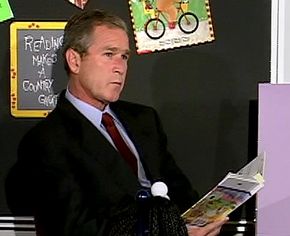
Bush then traveled to an elementary school for a community outreach photo opportunity which had been well-publicized for several days. It was reported that “Police and Secret Service Agents were on the roof, on horseback and in every hallway” at the school.[2] Every visitor at the school was required to attend a preparation meeting two days before, and all the phone lines had been tapped. The school’s principal stated, “It was the safest place in the world. If you blew your nose and it wasn’t time for you to blow your nose, they knew it.”[3]

The agency was protecting Bush very well, but not from terrorists in hijacked airplanes. Bush entered the classroom at 9:03 am that day, after it was widely known that the country was under attack. As stated by authors Allan Wood and Paul Thompson:

“By that time, the Federal Aviation Administration (FAA), the North American Aerospace Defense Command (NORAD), the National Military Command Center, the Pentagon, the White House, the Secret Service, and Canada’s Strategic Command all knew that three commercial airplanes had been hijacked. They knew that one plane had been flown deliberately into the World Trade Center’s North Tower; a second plane was wildly off course and also heading toward Manhattan; and a third plane had abruptly turned around over Ohio and was flying back toward Washington, DC.” [4]

Given the widespread knowledge that terrorists were hijacking planes and that planes were crashing into buildings, the Secret Service should never have let the president enter the building where he was scheduled to be located. The situation got worse, however, because shortly after Bush sat down, he was informed by his Chief of Staff that the World Trade Center had been hit again, by a second plane. Still there was no intervention by the Secret Service to remove the president from this well-publicized location.

Either failure to protect the president, or knowledge that he was not a target

Bush remained at the school until 9:35 am, more than 35 minutes after he arrived. He even gave a televised speech during that time, letting the world know he was still there. The actions of Bush and his Secret Service detail indicate that they were not worried at all about a terrorist attack against the school. Philip Melanson, author of a book on the Secret Service, described how odd this was by writing that, in an “unfolding terrorist attack, the procedure should have been to get the president to the closest secure location as quickly as possible.”[5]

This failure to follow Secret Service standard procedures is a glaring discrepancy to this day and it leads to a number of important questions. Who was responsible for making the decision to leave the president and everyone in the building at risk? Were the Secret Service agents traveling with the president in contact with the agency’s offices in Washington or New York? The largest Secret Service field office in the country was located in WTC Building 7, which was evacuated by the time Bush was entering the classroom.

The Secret Service supervisor traveling with the president, who was in charge of the president’s movements that day, was Edward Marinzel. It was Marinzel who should have been in charge of the execution (or non-execution) of the emergency action protocols carried out as the attacks were proceeding.[6]

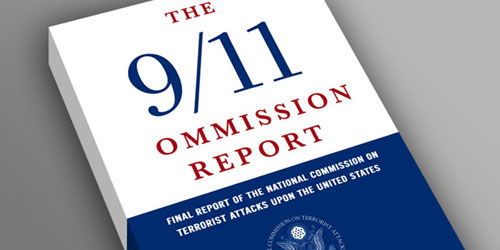
In an attempt to explain the failure to follow Secret Service procedures, the 9/11 Commission said in its report that Bush “told us his instinct was to project calm, not to have the country see an excited reaction at a moment of crisis,” and that the Secret Service “told us they were anxious to move the president to a safer location, but did not think it imperative for him to run out the door.” These official responses from the Secret Service, given in the 9/11 Commission Report (911CR), were taken from an as-yet unreleased 2004 interview with Edward Marinzel.[7] However, the Commission said nothing about why Bush entered the classroom in the first place, when everyone in government knew that the country was under attack.

It seems possible that Marinzel’s authority was somehow overridden, because reporters noticed that it was White House spokesman Ari Fleischer who appeared to be calling the shots while Bush sat there doing nothing. As Bush’s Secret Service detail failed to protect him, Fleischer maneuvered to get his attention without alerting the press. Several reporters noticed that Fleischer had written the words “DON’T SAY ANYTHING YET” in big block letters on a paper sign and was mouthing these words to Bush as he sat there.[8]

Another apparent failure of the Secret Service was that it did not immediately request air cover for either the president’s motorcade as it traveled to the airport, or for Air Force One, which took off at about 9:54. This seems to be another indication that the Secret Service knew that Bush was not in danger.

The lack of immediate request for air cover for the president’s escort becomes more difficult to understand considering the 911CR’s claims of an “unnerving false alarm” which was a “threat against Air Force One itself.” This threat was later “run down to a misunderstood communication in the hectic White House Situation Room” (p 325).

The 911CR did not cover the failure to request immediate air cover, but it did attempt to address the circuitous travels of Air Force One after it left Sarasota. Air Force One was redirected throughout the day, first to Barksdale Air Force Base (AFB) in Louisiana and then on to Nebraska. The 911CR states that the reason for this wandering about the country was that the “Lead Secret Service agent…felt strongly that the situation in Washington was too unstable for the President to return there,” and although the Bush“strongly wanted to return to Washington,” the Secret Service won the argument. Again, the 9/11 Commission got its information on this subject from the unreleased 2004 interview with Edward Marinzel.

Exactly why Edward Marinzel’s interview has not been made publicly available is not clear. Given that it was the primary basis for the official account with regard to the failure to protect the president, it seems that the public has a right to see it. Did the Secret Service know that the president was not in danger and, if so, how did it know that?

Whatever the case might be, Marinzel’s actions or lack thereof were considered appropriate because his role in protecting the president continued. On Thanksgiving in 2003, Marinzel led the team that planned and executed President Bush’s covert visit to Baghdad which, at the time, “was the first operation in history that took a President of the United States into an active war zone.”[9]

Today, Marinzel works at a consulting company with Ralph Basham, the former Director of the Secret Service (2003-2006), as well as another person who played a critical role in George W. Bush’s travel, communications and protection. This was Joseph W. Hagin, who was Bush’s deputy White House Chief of Staff for Operations (2001-2008). Mr. Hagin had previously been an assistant to Vice President George H.W. Bush, from 1981 to 1985, and then Assistant to President Bush from 1989 to 1991.

Hagin came to the George W. Bush administration after eight years as a vice president for Chiquita Brands International. Formerly called United Fruit Company, the company was mired in scandal at the time of Hagin’s departure, due to an expose by the Cincinnati Enquirer which claimed that it mistreated the workers on its Central American plantations, polluted the environment, allowed cocaine to be brought to the United States on its ships, and bribed foreign officials.

On 9/11, Mr. Hagin had oversight responsibility for Air Force One, the White House Communications Agency, and the Secret Service PPD.Despite these far reaching responsibilities, his name does not appear in the 911CR. Hagin was later “one of the principals responsible for planning the formation of the U.S. Department of Homeland Security.”[10] When Hurricane Katrina occurred, Hagin was the White House point person in terms of overseeing response efforts.

Either failure to protect the vice president, or reconstruction of the timeline

The 911CR states that when the Secret Service first learned of the second plane hitting the World Trade Center, it immediately initiated a number of precautionary “security enhancements around the White House complex.”[11] This would have begun at 9:03, when the entire nation witnessed Flight 175 hit the south tower on live television.

This information was obtained from the interview of Carl Truscott, who served as the Special Agent in Charge (SAIC) of the Presidential Protective Division (PPD). Truscott had primary responsibility for supervising all protective matters relating to the president, the first family and the White House. Although Truscott’s interview was not released in transcript form, a summary of the interview was made available as part of several random documents released via FOIA request to 9/11 researcher Aidan Monaghan.[12]

When the second plane hit the WTC, the Secret Service agent responsible for coordinating with the Federal Aviation Administration (FAA), Nelson Garabito, called his FAA counterpart, Terry Van Steenbergen. At the time, Garabito was at the Secret Service Joint Operations Center (JOC), located in the White House.

It was reported that Van Steenbergen told Garabito that two other planes were possibly hijacked, which caused Garabito to ask someone to run upstairs and pass the information on to other Secret Service agents. The 911CR states that this information was “either not passed on or was passed on but not disseminated.”

This failure relates to the question of when the vice president was evacuated from his office. If Van Steenbergen’s information, given to Garabito just after 9:03 am, was passed on to those protecting the vice president, then it would become important to know why the vice president was not moved to a safer location until 9:36, as stated by the 911CR. If the information was passed on immediately, and the vice president was moved to a secure location just after 9:00 as several witnesses have suggested, then his early presence at the Presidential Emergency Operations Center (PEOC) would substantiate the important testimony of Transportation Secretary Norman Mineta. According to Mineta, Cheney was being given regular updates on the progress of the hijacked Flight 77 as it came toward Washington.[13]

The documents released by FOIA request include a timeline of “Actions of TSD” on 9/11. TSD is the Secret Service’s Technical Services Division which, among other things, operates the Secret Service’s Tigerwall air surveillance system. The TSD timeline states that at 9:18 am “SAIC Truscott learned that an aircraft had been identified en-route to the Washington area.” Therefore, we have officially prepared documentation that indicates Truscott was aware of a hijacked plane heading for Washington at least 18 minutes before the official account says the vice president was moved from his office. If this is true, the public deserves to know why the vice president not moved to safety immediately. On the other hand if he was moved earlier, that fact supports Mineta’s astonishing and important testimony.

Failure to request interceptor jets in a timely manner

As described by author Michael Ruppert, the Secret Service was getting information about the ongoing hijacking events at the same time, or before, the FAA was. This was because there was a “parallel command system in play.”[14] This parallel command system was also described by Richard Clarke, who was leading one of the response teams in the White House Situation Room (WHSR). Clarke later wrote that Brian Stafford, the Director of the Secret Service, was in the WHSR with him and was passing him information. That information, according to Clarke, came from the fact that the Secret Service had “a system that allowed them to see what FAA’s radar was seeing.”

The authoritative command system appeared to be below ground in the PEOC, where Dick Cheney was leading the activities. The TSD document released by FOIA shows that when Assistant Division Chief Spriggs arrived in the PEOC, at 9:30 am, Cheney and Rice were already there along with ten other “presidential and vice presidential staff.”[15] Carl Truscott was the lead Secret Service agent in the PEOC, the one who was in coordination with Garabito, and the one who was most closely coordinating with Dick Cheney.

The FOIA-released 9/11 Commission summary of Truscott’s interview says that he escorted NSA Rice from the Situation Room to the “White House Shelter Area” where they met Cheney, who was on the phone, and Mrs. Cheney.[16] Interestingly, the official account gives a contradictory account, stating that Mrs. Cheney did not arrive at the White House for another 30 minutes or more. The FOIA documents say that Truscott led the Cheneys and Rice to the PEOC sometime before 9:30 am.SAIC Anthony Zotto, who was specifically responsible for the vice president’s safety, was in the PEOC at the time. This means that Cheney was in the PEOC at least 8 minutes before Flight 77 crashed into the Pentagon.

The documents released by the Secret Service via FOIA indicate that the Secret Service had knowledge of Flight 77 and Flight 93 and that those flights were headed toward Washington, DC. One of these documents, not well identified but apparently a timeline created by one agent to relate his experiences, indicates that the Secret Service had knowledge of “two more outstanding aircraft, not responding to the Tower, considered suspect and at least one was headed toward DC.” This was several minutes before the agent arrived at “Room 552 en route to the JOC” where the agent learned that “one of the two planes, believed to be hijacked, was approximately 5 minutes out from DC.”

These documents confirm that the Secret Service knew that two hijacked planes were headed toward Washington during the time that Cheney and SAIC Truscott were in the PEOC, and well before Flight 77 was reported to have crashed into the Pentagon. Cheney seemed to confirm the same when he later said, on NBC’s Meet the Press — “The Secret Service has an arrangement with the FAA. They had open lines after the World Trade Center was…” — and then cut himself off.

There remains some confusion over whether the Secret Service ordered, or had the authority to order, the scrambling of interceptor jets from Andrews AFB in response to the knowledge about the incoming hijacked aircraft. Author Lynn Spencer, who NORAD Commander General Ralph Eberhart says “tells it all and tells it well,” wrote that “the Secret Service also has certain authority over the military and, in this case, the DC Guard.”[17] That is, the Secret Service had the authority to order the scrambling of interceptor jets on 9/11. And of course, with the president indisposed for a brief period, the vice president was the commander in chief of the military.

Official reports now suggest that the Secret Service made such a request, although very late in the chain of events, but that Andrews commander General David Wherley did not respond rapidly enough. The reason given is that Wherley did not recognize the Secret Service as having the authority to order jets to scramble and therefore he waited until someone in the military chain of command gave him the order. Unfortunately, General Wherley is no longer available for comment as he died in a freak train accident which was “the most deadly train crash in the history of the Washington Metropolitan Area Transit Authority.”[18]

However, it is clear that Andrews AFB staff reached out to the Secret Service well before Wherley ever got involved.[19] Just after 9:05, Major Daniel Caine, the supervisor of flying at Andrews AFB, called his Secret Service contact, Kenneth Beachamp. Caine asked, “Are you guys going to need some help?” Agent Beauchamp replied, “No, but I’ll call you back if that changes.” Beauchamp, whose 9/11-related interview is still “national security classified,” never called back. Nearly 30 minutes later, when Flight 77 was coming into Washington, someone else from the Secret Service finally returned Caine’s call to accept the offer of assistance. Upon answering the phone, Caine stated that he “could hear plain as day the vice president talking in the background.”[20] That was when Caine’s newly arrived superior, General Wherley, began spending another 80 minutes or more being confused about the chain of command, according to the official account.

Interceptor jets did not launch from Andrews AFB, which was only ten miles from the Pentagon, until 10:38 am (and those were not armed). This was more than an hour after the Pentagon was hit, almost two and a half hours after the first plane was known to be hijacked, and approximately 90 minutes after Major Caine had first offered assistance to the Secret Service.

TruscottSAIC Truscott continued as the leader of the Secret Service PPD through 2005, during the times when a male prostitute came to the White House for overnight visits, and during the period when Jack Abramoff was visiting the White House. The White House later tried to hide the records for these visits. Truscott was also at the White House during the period when the Secret Service adopted its secretive processes for records management with regard to visitor records.

Like Marinzel, Truscott’s performance on 9/11 was apparently well received as he was later promoted to Director of the ATF, another major agency of the U.S. Department of Treasury. In the end he was forced to resign in a scandal related to multiple abuses of power including sexist orders given to female employees. Truscott had friends in high places, however, and he was protected from prosecution by order of the White House.[21] Truscott went on to join ASERO Worldwide, an international security and risk management firm run by Doron Bergerbest-Eilon, who was formerly the most senior ranking security official at the Israeli Security Agency.[22]

Overall, the response of the Secret Service to the 9/11 attacks suggests foreknowledge of the events in that the agency failed to protect the president from the obvious danger posed by terrorists. That foreknowledge, combined with the failure of the Secret Service to follow-up on the offer of air support from Andrews AFB, leads to the suspicion that the agency was complicit in the attacks. Revealing the truth behind these suspicions will require that the central role players from the Secret Service and the White House, including Edward Marinzel, Ari Fleischer, Joseph Hagin, Carl Truscott, Anthony Zotto, and Kenneth Beauchamp, be examined under oath by prosecutors with subpoena power.

[1] Allan Wood and Paul Thompson, An Interesting Day: President Bush’s Movements and Actions on 9/11, History Commons Complete 9/11 Timeline, http://www.historycommons.org/essay.jsp?article=essayaninterestingday

[2] Shoestring 9/11 Blog, The 90-Minute Stand Down on 9/11: Why Was the Secret Service’s Early Request for Fighter Jets Ignored?, December 20, 2009, http://shoestring911.blogspot.com/2009/12/90-minute-stand-down-on-911-why-was.html

[3] Tom Bayles, The Day Before Everything Changed, President Bush Touched Locals’ Lives, The Sarasota Herald-Tribune, September 10, 2002, http://s3.amazonaws.com/911timeline/2002/sarasotaheraldtribune091002.html

[4] Allan Wood and Paul Thompson

[5] Philip H. Melanson, Secret Service: The Hiddine History of an Enigmatic Agency, Carroll & Graf, 2002

[6] Command Consulting, Bio for Edward Marrnizel, http://www.commandcg.com/en/edward-marinzel

[7] For references to the 2004 Edward Marinzel interview, see The 9/11 Commission Report, footnotes 204 and 207 from Chapter 1, and footnotes 1 to 3 from Chapter 10

[8] 911Research.wtc7.net, George W. Bush: Cover Stories of the People in Charge, http://911research.wtc7.net/disinfo/alibis/bush.html

[9] Command Consulting, Bio for Edward Marrnizel

[10] Command Consulting, Bio for Joseph Hagin, http://www.commandcg.com/en/joseph-w-hagin

[11] The 9/11 Commission Report, page 36

[12] FOIA documents released by the U.S. Secret Service to Aidan Monaghan on April 23, 2010.http://www.mediafire.com/?vydb4nxdmyy

[13] George Washington’s Blog, Mineta’s testimony CONFIRMED, March 04, 2007, http://georgewashington.blogspot.com/2007/03/minetas-testimony-confirmed.html

[14] Michael C. Ruppert, Crossing the Rubicon (chapter 24), New Society Publishers, 2004

[15] FOIA documents released by the U.S. Secret Service

[16] 9/11 Commission summary of “USSS Statement and interview reports,” dated July 28, 2003, http://www.scribd.com/doc/14353654/DH-B5-Secret-Service-Requests-Fdr-Entire-Contents-5-Withdrawal-Notice-Doc-Req-Notes-Garabito-Shortly-After-9am-FAA-Van-Steenbergen-Said-4-Planes

[17] Lynn Spencer, Touching History: The untold story of the drama that unfolded in the skies over America on 9/11, Free Press, 2008

[18] Christopher Conkey, Retired Major General Wherley Died in Crash, Wall Street Journal, June 24, 2009, http://online.wsj.com/article/SB124581129913745441.html

[19] Shoestring 9/11 Blog, The 90-Minute Stand Down on 9/11: Why Was the Secret Service’s Early Request for Fighter Jets Ignored?, December 20, 2009, http://shoestring911.blogspot.com/2009/12/90-minute-stand-down-on-911-why-was.html

[20] History Commons Complete 9/11 Timeline, Profile: Daniel Caine, http://www.historycommons.org/entity.jsp?entity=dan_caine

[21] Empty Wheel, Who Is Carl Truscott and Why Did Bush’s DOJ Protect Him?, March 5, 2008, http://www.emptywheel.net/2008/03/05/who-is-carl-truscott-and-why-did-bushs-doj-protect-him/

[22] Bloomberg Businessweek profile for ASERO Worldwide, http://investing.businessweek.com/research/stocks/private/snapshot.asp?privcapId=127598609

Posted in 9/11, 9/11 Suspects | 2 Comments

Muslims Did Not Attack the U.S. on 9/11

Since September 11, 2001, the United States has initiated a number of wars in Muslim countries. These wars, which would be more correctly called massacres, have resulted in the deaths of countless innocent Muslims.  In some cases, attempts have been made to present these aggressions in the guise of humanitarian efforts to promote democracy.  But the limited public support for U.S. military action around the world goes back to the U.S. government claim that Muslims were responsible for 9/11. This claim is untrue and it is past time for people to recognize that fact.

There are many ways to see that Muslims were not responsible for 9/11.  Author David Ray Griffin has previously made arguments in this regard.[1]  As time goes on, however, more facts lead people to realize that claims of Muslim responsibility for terrorism in the U.S. should be highly suspect. These facts include that the October 2001 anthrax attacks were blamed on Muslims only to be later traced to a U.S. military facility and to non-Muslim, U.S. scientists.  Moreover, a number of FBI-planned acts of terrorism since 2001 have been falsely attributed to young Muslims who were victims of appalling acts of entrapment by the FBI.[2]

According to the official account of 9/11, nineteen young Arab Muslims were responsible for the entirety of the mass murder that day. The FBI accused these young men within 72 hours of the attacks and, although the list changed slightly at first, it has remained the same since shortly after the attacks.  To support the accusations, U.S. authorities pointed to passports that were found under implausible circumstances, luggage containing unbelievably convenient documents, and other dubious evidence.

In October 2001, reporter Seymour Hersh wrote —

“Many of the investigators believe that some of the initial clues that were uncovered about the terrorists’ identities and preparations, such as flight manuals, were meant to be found. A former high-level intelligence official told me, ‘Whatever trail was left was left deliberately—for the F.B.I. to chase.’”[3]

Years later, the 9/11 Commission Report (911CR) was written by a professional myth-maker, Phillip Zelikow, who was also a Bush Administration insider.  Oddly enough, the outline for the report was written by Zelikow and his colleague Ernest May even before the investigation began.  It is now widely accepted that the 9/11 Commission and the FBI did very poorly in terms of investigating most aspects of the attacks. In just one example, the FBI never even interviewed the people suspected of engaging in 9/11 insider trading.[4]

Despite the poor quality of the investigation, the 911CR used inflammatory language which focused on Muslims as “the enemy.”  The Commission told us that “the enemy rallies broad support in the Arab and Muslim world by demanding redress of political grievances, but its hostility toward us and our values is limitless.”  The Commission was being false and misleading when it made these statements, however, as the evidence shows that 9/11 was not a Muslim crime.

Muslims do not Murder Innocent People

The most obvious reason that the Commission was off-track is that Muslims do not murder innocent people.  Some people find this statement outrageous.  Of course Muslims murder innocent people, they say, that’s what al Qaeda does.

The problem is that, as a society, many of us have been trained to accept religion as a noncommittal affiliation or label.  For example, many of the current U.S. leaders have engaged in mass murder around the world over the last ten years yet they still call themselves Christians.  Anyone can see that they are not. Those who truly believe in God live by the laws of the religion they proclaim and Christians do not engage in wars of aggression or the torture and killing of other human beings.

The word “Muslim” is Arabic and literally means “one who submits (to God).”  But Webster’s Dictionary defines a “Muslim” as an adherent to Islam.  Being an adherent of Islam means to follow the teachings of the Holy Qu’ran.  And according to the Qur’an, one of the greatest sins is to kill a human being who has committed no fault:

  • “If someone kills another person – unless it is in retaliation for someone else or for causing corruption in the earth – it is as if he had murdered all mankind.”  (Surat al-Ma’ida: 32)

Defenders of the official myth might say that the 9/11 attacks can be seen as retaliation for the corruption in U.S. financial (WTC) and military (Pentagon) activities.  Problems with that argument include the fact that it doesn’t absolve the 9/11 terrorists from having killed many innocent people, including children and dozens of Muslims.[4]  It also doesn’t explain how many of the financial leaders in the WTC, and all of the top military leaders at the Pentagon, escaped with their lives.

Furthermore, polls in countries with large Muslim populations indicate that Muslims oppose the killing of civilians in warfare significantly more than non-Muslims do.  People in Muslim countries “roundly reject attacks on civilians. Asked about politically-motivated attacks on civilians, such as bombings or assassinations, majorities in all countries—usually overwhelming majorities—take the strongest position offered by saying such violence cannot be justified at all.”[6]

To avoid this direct problem, some say that the alleged 9/11 hijackers were nominally Muslims. In other words, they were people who called themselves Muslims but who just didn’t follow this one requirement of the Qu’ran.  This article doesn’t delve into the carefully cultivated phenomenon called “radical Islam,” but the evidence we have indicates that the men accused of hijacking planes on 9/11 were either not involved at all, or were not even close to being adherents of Islam.

The Men Accused of Hijacking the Planes Were Either Not Involved or Were Not Muslims

In the weeks after 9/11, many mainstream news sources reported that the accused hijackers were still alive.  These claims were reported by major media sources like The Independent, the London Telegraph and the British Broadcasting Corporation. Although BBC attempted to retract the claims later, the Telegraph reported that it had interviewed some of these men, who the newspaper said had the same names, same dates of birth, same places of birth, and same occupations as the accused.[7]

No other media sources have successfully explained the discrepancies around the reports of the alleged hijackers still being alive.  One particularly weak attempt, cited as the primary source at Wikipedia, was an absurd hand-waving piece in Der Spiegel that used “U.S. Historian Daniel Pipes” as the authority.[8]  Not mentioned is the fact that Pipes, a second-generation neocon and Project for the New American Century signatory, is arguably the world’s leading Islamophobe.[9]

Most importantly, the “hijackers alive” reports were not investigated by the FBI or the 9/11 Commission. In fact, the Director of the FBI, Robert Mueller, publicly expressed doubts about the identity of the hijackers.  Yet to this day there has been no official response to these contradictions despite their high relevance to the overall investigation.

We can imagine that these cases were probably the result of stolen identities and some follow-up media statements suggested just that. With the likelihood of stolen identities, and without an official investigation to clarify, we are left with the conclusion that some of the accused men were not involved.  It could be that there may have been other people involved who have never been identified, but without facts to go on we cannot say.

The men who appear to have been falsely accused include the brothers Wail and Waleed al Shehri, and Abdulaziz al Omari.[10]  The language in the 911CR suggests that al Omari was the most devout of the accused men, in that he “often served as an imam at his mosque in Saudi Arabia.”  But since his identity was stolen and he was therefore not involved, we must look to the other accused men for Muslim connections.

Others who appear to be victims of identity theft include Mohand al Shehri, Salem al Hazmi, Saeed al Ghamdi, and Ahmed al Nami.  Although the Commission’s report states that al Ghamdi “attended prayer services regularly,” he was also reported to have trained at the Lackland Air Force Base’s Defense Language Institute, which is a fact that does not support his being a religious fanatic with limitless hostility toward the United States. The report also says of al Hazmi that he was “unconcerned with religion.”   In any case, these four must be excluded from the oxymoronic label of “Muslim terrorist” because it appears they were falsely accused.

Another of the accused men who the Commission says was “unconcerned with religion” was Satam al Suqami.  This description appears to be correct because, according to The Boston Globe, al Saqami liked to sleep with prostitutes, which is a decidedly non-Muslim activity.[11]  In Islam, prostitution and other forms of sexual deviancy are forbidden.  Therefore, although al Suqami was not reported to be still alive, he was not a Muslim.

In the months and days leading up to 9/11, the alleged hijackers were reported to have drank alcohol heavily in bars, purchased pornographic materials, watched strippers, and paid for lap dances.  Needless to say, people who follow the teachings of the Qu’ran (Muslims) do not do any of those things.

As Temple University professor of Islamic Studies, Mahmoud Mustafa Ayoub, said in relation to the alleged 9/11 hijackers—“Islam does not condone killing innocent people in the name of God. Nor can a devout Muslim drink booze or party at a strip club and expect to reach heaven.”[12]

Two of the men were being watched by the CIA for at least twenty months prior to 9/11.  These were Nawaf al Hazmi and Khalid al Mihdhar, and they did not follow the Qu’ran either.  As reported by the Los Angeles Times, these two were often seen at Cheetah’s, a nude bar in San Diego.

The most glaring examples of non-Muslim behavior, however, were exhibited by the alleged hijacker pilots of American Airlines Flight 11 and United Airlines Flight 175.  According to the 911CR, Mohammed Atta and Marwan al Shehhi piloted these airliners and crashed them into the WTC towers. Public knowledge about them indicates that they might have been trained at U.S. military facilities, but it is clear that they did not even try to follow the Qu’ran.  Frankly, Phillip Zelikow is more of a Muslim than they were.

For one thing, Atta and al Shehhi were known to dress in gaudy jewelry and clothes. Because of this, people thought they were mafia characters. As author Daniel Hopsicker wrote, they wore “Gold jewelry, expensive watches, and silk shirts” and were “Not exactly a description of Islamic fundamentalists.”[13]  Additionally, their activities in Florida, in the years prior to 9/11, were closely aligned with those of gunrunners and drug smugglers, which also indicates that they were anything but Muslims.

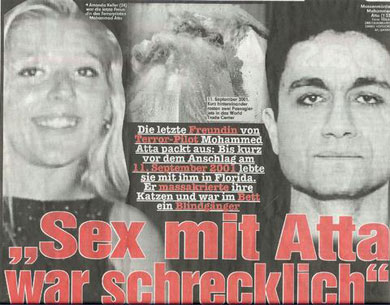
Atta’s stripper girlfriend, Amanda Keller, said that Atta and al Shehhi “had massive supplies of cocaine” which they restocked whenever needed at one of the flight schools run by Dutch nationals in Florida.  Keller said that during the time she dated him, she saw Atta do cocaine himself on multiple occasions.[14]  And, of course, Muslims don’t do cocaine or other illicit drugs.

Witnesses saw Al Shehhi and Atta drunk at a Hollywood, Florida sports bar.  On another occasion in Palm Beach, Atta and Alshehhi were seen spending $1,000 on champagne in only 45 minutes.  During the latter escapade, Atta was with a tall busty brunette and Alshehhi was with a short blonde woman. Both women were known locally as high-priced escorts.[15]

A stripper in Las Vegas, Nevada recalled that Marwan al Shehhi was “cheap,” because he paid only $20 for a lap dance. In the summer of 2001, Al Shehhi was apparently also seen in a nude bar in Pompado Beach, Florida.  Six exotic dancers who worked there testified to seeing him. At the same time, both al Shehhi and Hamza Alghamdi were witnessed purchasing pornographic video and sex toys from a Florida store.  The Wall Street Journal reported that Alghamdi watched a porn video in his hotel room, and others witnessed alleged hijacker Majed Moqed visiting a porn shop on several occasions in the months before 9/11.[16]

This same categorically non-Muslim behavior was also true for Ziad Jarrah, the alleged hijacker pilot of Flight 93, which was destroyed in a field in Pennsylvania.  Seven months before the attacks, it was noticed that Jarrah “frequented” a strip club in Jacksonville, Florida.[17]

The 911CR says that six of the alleged hijackers lived in Paterson, NJ for up to six months.  This included Hani Hanjour, Nawaf al Hazmi, Khalid al Mihdhar, the man mis-identified as Abdulaziz al Omari, and others.  Reports put Ziad Jarrah in Paterson as well.  The mayor of Paterson, Marty Barnes, certainly noticed them and he made the point of how non-Muslim they were, saying—“Nobody ever saw them at mosques, but they liked the go-go clubs.”[18]

Given that Atta and friends were so far from being Muslims, it actually makes sense that the U.S. government would try, in the days after 9/11, to bolster the political story by adding actual Muslims to its quickly drawn-up list.  The real al Omari, for example, was obviously not involved.  But the discrepancy between his being an imam and a go-go club aficionado who never went to the mosques would quickly be lost in the post-9/11 clamor for revenge.  And the public’s most banal and prejudiced tendencies could be better exploited with hints of Muslim connections, no matter how weak, just as they have been with the anthrax attacks and the ongoing FBI-planned terrorism.

In any case because the alleged hijacker pilots were clearly not Muslims, the deaths caused by the destruction of those planes cannot be attributed to Muslims. This includes the deaths of the airplane passengers and the people in the impact zones of the WTC.

The Alleged Hijackers Were Not Responsible Most of the Deaths, If Any

The 911CR says that Hani Hanjour, the accused hijacker pilot of American Airlines Flight 77, was the terrorist operation’s most experienced pilot. The official account tells us that he slammed the aircraft into the Pentagon at the first-floor level going over 500 mph.  But all the evidence indicates that he was a very poor pilot at best. He repeatedly failed his training courses on single engine aircraft and according to representatives of his flight training schools he had no fundamental pilot skills.[19]  Due to these facts, we know that Hanjour could not have flown the plane as alleged.  So it doesn’t matter if he was a Muslim.

It is possible that all the planes were commandeered by way of existing remote control technology, which would explain a number of the unanswered questions.[20]  Remote piloting could explain why the planes did not squawk the hijack code, why the auto-pilot stayed on during the hijacking process, and how these planes were flown with extreme precision at very high speeds regardless of the poor skills of the alleged pilots.  It would also explain how those who planned the attacks could have remained confident of their success, despite having employed unreliable, cocaine-snorting, alcoholic perverts as “hijackers.”

Regardless of who actually flew the planes, we know that most of the deaths on 9/11 were the result of actions which could not have been accomplished by the accused men.  Of course, the initial hijackings could be blamed on the alleged, non-Muslim hijackers and one might argue that some passengers and crew members were said to be killed during the hijackings.  But so little is known about how the hijackings occurred that it is difficult to know what really happened.  The 9/11 Commission could not even say how the alleged hijackers entered the cockpits of any of the four planes, or why the hijack code was not squawked for any of them.

If we examine what was needed to facilitate the attacks, we see that most of the deaths on 9/11 were the result of many things that should not have happened.  And none of it could have been accomplished without the involvement of U.S. authorities.

  1. Pre-9/11 investigations that would have caught the accused men were shut down.
  2. All the levels of hijacking prevention failed four separate times.
  3. For several hours, our leaders did nothing to protect the nation.
  4. The planes should have been intercepted but they were not.[21]
  5. The planes were flown like guided missiles.
  6. Three WTC skyscrapers were completely destroyed, and all of them fell through what should have been the path of most resistance.[22]
  7. Evidence for explosives at the Pentagon was discovered and not explained.
  8. The debris damage in Pennsylvania indicates that Flight 93 was shot down.

An extensive examination of the people who had access to the WTC towers shows that the accused men were not among those who could have placed explosives in those highly-secure buildings, nor were any Muslims known to be in such a position.[23]  Therefore, there is no evidence whatsoever that the accused non-Muslims, or any unspecified Muslims, caused the deaths of the nearly 2,600 people who were killed in the destruction of the Twin Towers.

It is reasonable to say, without an extensive inquiry, that Muslims could not have shut down the pre-9/11 investigations. Similarly, they could not have caused the repeated failure of a hijacking prevention system that had been successful for over 20 years.  Muslims certainly could not have stopped U.S. leaders from doing their jobs on 9/11, nor could they have disabled the U.S. air defenses or shot down Flight 93.

Additionally, there is no doubt that Muslims were not to blame for delaying and obstructing the investigation into 9/11, during which time the U.S. and its allies had already initiated massacres in the Middle East. The official accounts that were finally generated, that ignored most of the important evidence and are transparently false, are not the work of Muslims either.  The murder of millions of people has been falsely justified by way of those official accounts.

Muslims could not have done any of these things. Not even the drug-abusing drunk called Mohammed Atta, who dated strippers, dressed like a gangster and hung out with drug runners, could have done those things.

Moving Beyond Islamophobia 

We do have clues about who might have been involved though. For example, Florida Governor Jeb Bush showed up at Rudi Dekkers’ flight school in Venice, Florida where Atta and several of the other accused men had trained, within 24-hours after the attacks, to confiscate all the school’s records.[24]  Curiously, Jeb and his brother, the President of the United States, had three relatives working for companies within the impact zones of the WTC towers (Craig Stapleton, Jim Pierce, and Prescott Bush Jr).[25]

Dekkers was a pervert just like the accused, non-Muslim men and he was brought up on charges for sexual harassment. Another of the many weird facts about Dekkers was that he claimed to be a New York City cop, and had a plaque on his wall with words to that effect.[26]  This might remind us of Bernard Kerik, the “9/11 hero” who led the New York City Police department when it was credited with providing some of the dubious evidence against the accused. Kerik not only dressed like a gangster, he was known to have associated with mafia characters.  Coincidentally, the same things were said about FBI agent and lead al Qaeda investigator, John O’Neill.

Kerik spent years working in Saudi Arabia, first for the Saudi royal family and then for one of the companies that later was located near the impact zone in the south tower.  Interestingly, Kerik was the first person to tell us that explosives were not involved in the destruction of the WTC.  Unfortunately, we can’t get follow-up comments from him because he’s now in prison.

There remain many avenues for further investigation into the accused hijackers and who they really were.  Could there be a connection between the porn shops and strip clubs that the accused men liked to visit, and covert activities or organized crime?  Could those connections lead from places like Las Vegas and Florida to New York City, and shed light on why so many mafia-linked companies were hired to clean-up the WTC site?

Could the links between Atta, Dekkers’ financier Wally Hilliard, and international drug-running have anything to do with creating a pretext for war in Afghanistan, the country that now leads the world in opium production?  That certainly would make sense given that the southwest Florida area near Venice, where Dekkers, Atta and the alleged hijackers spent so much time, was home to a long history of CIA and drug trafficking operations.

Two long-time law enforcement officers interviewed by Daniel Hopsicker said they had “witnessed a 40-year long history of CIA-connected covert operations in their area.”  They were describing Atta’s home port in early 2001, the Charlotte County Airport.  They added that “they believed that the CIA was somehow involved, if not responsible for, the World Trade Center attacks.”[27]

Forty years is not quite right, however, as the history of covert drug operations in that area went back at least 60 years.  The tiny Venice Airport, where most of the alleged hijackers trained, originated as the Venice Army Airfield and was the home of the operatives who worked for General Claire Chennault.[28] Civil Air Transport, the successor to Chennault’s Flying Tigers and the world’s largest heroin-trafficking operation at the time, transported the drugs that funded the early covert operations of the CIA, and those airmen worked closely with organized crime while doing so.[29]

For the 12 years prior to 9/11, drug trafficking and terrorist training in the Venice, Florida area was overlooked by the region’s congressional representative, former CIA operative Porter Goss, and its Senator, Bob Graham.  It might not be surprising then, to notice that Goss and Graham led the first official inquiry into the 9/11 attacks. They didn’t find much.

Unfortunately, these leads are not being investigated due to continued support for the false claim that the alleged hijackers were adherents of Islam.  Such support for the official conspiracy theory also promotes the ongoing Muslim genocide.  We don’t know where all this falsehood will lead in the future, but people who seek the truth about 9/11 should move beyond blaming Muslims and get back to useful investigative work.


[1] David Ray Griffin, Was America Attacked by Muslims on 9/11?, information Clearing House, September 8, 2008, http://www.informationclearinghouse.info/article20722.htm

[2] Glenn Greenwald, The FBI again thwarts its own Terror plot, Salon, Sep 29, 2011, http://www.salon.com/2011/09/29/fbi_terror/

[3] Seymour M. Hersh, What Went Wrong, The New Yorker, October 8, 2001,  http://www.newyorker.com/archive/2001/10/08/011008fa_FACT

[4] Kevin R. Ryan, Evidence for Informed Trading on the Attacks of September 11, Foreign Policy Journal, http://www.foreignpolicyjournal.com/2010/11/18/evidence-for-informed-trading-on-the-attacks-of-september-11/

[5] Huda, Muslim Victims of 9/11 Attack: Several dozen Muslims were among the innocent victims, About.com, http://islam.about.com/od/terrorism/a/Muslim-Victims-Of-9-11-Attack.htm

[6] Program on International Policy Attitudes, Muslims Believe US Seeks to Undermine Islam, April 24, 2007, http://www.worldpublicopinion.org/pipa/articles/brmiddleeastnafricara/346.php

[7] David Harrison, Revealed: the men with stolen identities, The Telegraph, 23 Sep 2001, http://www.telegraph.co.uk/news/worldnews/middleeast/saudiarabia/1341391/Revealed-the-men-with-stolen-identities.html

[8] Der Spiegel, Panoply of the Absurd, September8, 2003, http://www.spiegel.de/international/spiegel/0,1518,265160,00.html

[9] Hillary Smith, The Main Purveyors of Islamophobia: Daniel Pipes, The Council for the National Interest, 18 January 2012,  http://www.councilforthenationalinterest.org/promoting-islamophobia/the-main-purveyors-of-islamophobia/item/1336-islamophobia%E2%80%99s-main-purveyors-daniel-pipes

[10] 911Research.wtc7.com, Resurrected Hijackers: Suicide Hijackers Identified by the FBI Proclaim Their Innocence, http://911research.wtc7.net/disinfo/deceptions/identities.html

[11] Shelley Murphy and Douglas Belkin, Hijackers Said to Seek Prostitutes, The Boston Globe, October 10, 2001, http://s3.amazonaws.com/911timeline/2001/bostonglobe101001.html

[12] Jody A. Benjamin, Suspects’ actions don’t add up, South Florida Sun-Sentinel, September 16 2001, http://web.archive.org/web/20010916150533/http://www.sun-sentinel.com/news/local/southflorida/sfl-warriors916.story

[13] Daniel Hopsicker, Welcome to Terrorland: Mohamed Atta & the 9-11 Cover-up in Florida, Trine Day; 2004

[14] Daniel Hopsicker, Welcome to Terrorland

[15] History Commons Complete 9/11 Timeline, Context of ‘Before September 11, 2001: 9/11 Hijackers Drink Alcohol and Watch Strip Shows, Especially towards Eve of Attacks, http://www.historycommons.org/context.jsp?item=a091101beforepinkpony

[16] Ibid

[17] Jackelyn Barnard, Exclusive: 9/11 Hijacker Stayed at Jacksonville Hotel, First Coast News, Aug 25, 2004, http://www.firstcoastnews.com/news/local/story.aspx?storyid=23296

[18] Evan Thomas, Cracking the Terror Code, Newsweek, October 15, 2001, http://www.wanttoknow.info/011015newsweek

[19] 911Research.wtc7.net, Clueless Super-Pilot, http://911research.wtc7.net/disinfo/deceptions/badpilots.html

[20] Aidan Monaghan, Plausibility Of 9/11 Aircraft Attacks Generated By GPS-Guided Aircraft Autopilot Systems, Journal of 9/11 Studies, October 2008, http://www.journalof911studies.com/volume/2008/AutopilotSystemsMonaghan.pdf

[21] Paul Thompson, The Failure to Defend the Skies on 9/11, History Commons, http://www.historycommons.org/essay.jsp?article=essayairdefense

[22] Frank Legge, Controlled Demolition at the WTC: a Historical Examination of the Case, Journal of 9/11 Studies, May, 2009, http://www.journalof911studies.com/volume/2009/LeggeCDatWTC.pdf

[23] Kevin R. Ryan, Demolition Access to the WTC Towers, found at 911Review.com, http://911review.com/articles/ryan/demolition_access_DonPaul.html

[24] Daniel Hopsicker, Welcome to Terrorland

[25] Kevin R. Ryan, Demolition Access to the WTC Towers

[26] Daniel Hopsicker, Welcome to Terrorland

[27] Daniel Hopsicker, Welcome to Terrorland

[28] Daniel Hopsicker, The Utimate Hedge?:  Venice Airport has a 60-Year History of Drug Trafficking, Mad Cow News, March 8, 2010, http://www.madcowprod.com/03082010.htm

[29] Kevin R. Ryan, Review of American War Machine, by Peter Dale Scott, 911Blogger.com, February 12, 2011, http://911blogger.com/news/2011-02-12/review-american-war-machine-peter-dale-scott

Posted in 9/11 | 44 Comments

KuwAm and Stratesec: Directors and Investors That Link 9/11 to a Private Intelligence Network

The Kuwaiti-American Corporation (KuwAm), parent company of World Trade Center (WTC) security company Stratesec, had some interesting links to royalty in both Iran and Kuwait.  Some of the company’s directors also had connections to U.S. intelligence agencies and at least one was associated with the CIA-funded terrorist financing network that included BCCI.  Through these links we can see that the origins of the War on Terror are related to the origins of the first Gulf War, and to a private network of covert operatives that stretches back for generations.

After the 1993 bombing, a company called Stratesec was responsible for the overall integration of the new WTC security system.  In the few years leading up to 9/11, Stratesec also had contracts to provide security services for United Airlines, which owned two of the planes that were destroyed on 9/11, and Dulles Airport where American Airlines Flight 77 took off.

Stratesec’s board of directors included Marvin Bush, the brother of George W. Bush, and Wirt Dexter Walker III, a distant relative of the Bush brothers.[1]  Marvin Bush joined the board of Stratesec after meeting members of the Al Sabah family on a trip to Kuwait with his father in April 1993.  During this trip, the Kuwaiti royals displayed enormous gratitude to the elder Bush for having saved their country from Saddam Hussein only two years earlier.

But the Bush-Kuwaiti connection went back much farther, to 1959, when the Kuwaitis helped to fund Bush’s start-up company, Zapata Off-Shore.  As a CIA business asset during this time, Bush and his company worked directly with the anti-Castro Cuban groups in Miami before and after the Bay of Pigs invasion.[2]

During the 1993 trip, the royals in the United Arab Emirates showed similar gratitude to the Bush family by putting Marvin on the board at Fresh Del Monte, which was purchased by the UAE-owned company IAT in 1994. The alleged 9/11 hijackers had many connections to the UAE, and much of the funding for the attacks came through that country.

Mish’al Yusuf Saud Al Sabah, the majority owner of KuwAm Corporation, was the company’s chairman since 1982. Just after the Bush family visit in 1993, KuwAm gained a controlling interest in Stratesec.[3]  The other owners of Stratesec were Walker, who along with Al Sabah joined the Stratesec board, and an entity controlled by Walker and Al Sabah, called Special Situation Investment Holdings (SSIH).  KuwAm owned several other companies, including Commander Aircraft and Strategic Jet Services , which were controlled under the Oklahoma-based company called Aviation General (AGI).

KuwAm’s aircraft companies had international clientele and Al Sabah was known to personally engage customers who purchased aircraft.[4]  In 1996, Al Sabah announced that AGI sold aircraft to the National Civil Aviation Training Organization (NCATO) in Giza, Egypt.  NCATO was in a partnership with Embry-Riddle University where two of the alleged 9/11 hijackers, Saeed Alghamdi and Waleed M. Al Shehri, were said to have gone to flight school.[5] Ten days after the attacks, Embry-Riddle was relieved to report that Al Shehri had turned up alive.[6] Unfortunately, the many reports that some of the alleged hijackers had turned up alive were never investigated by the FBI or the 9/11 Commission.

Like Stratesec, all three of KuwAm’s aircraft companies went bankrupt within three years after 9/11.  The company blamed terrorism and the war in Iraq for a reduced demand for its products.[7] Despite the losses, the Kuwaiti royal family can be said to have benefited from 9/11 due to “The War on Terror” that removed Saddam Hussein from power. Of course, that was the second consecutive US war that Kuwait benefited from, the first being the 1991 Gulf War led by President George H.W. Bush.

The 1991 Gulf War was started on the basis of blatant lies, at least one of which involved a relative of Mish’al Al Sabah. This was a 15-year old girl named Nayirah, who was the daughter of Mish’al’s first cousin, Saud Nasser Al Saud Al Sabah, the Kuwaiti ambassador to the United States.[8] The girl lied about having witnessed Iraqi soldiers taking babies out of incubators and leaving them on the “cold floor to die.” It was later learned that her testimony was false and that she had been coached to tell the lies by the public relations firm, Hill & Knowlton.[9]

Needless to say, Mish’al Al Sabah is very well connected to the Kuwaiti royal family and, therefore, to the Kuwaiti government.  Other first cousins of Mish’al included Salim Abdal-Aziz Saud Al Sabah, the Governor of Kuwait’s Central Bank, and Sabah Nasir Saud Al Sabah, the Head of the Engineering Department for Military Projects in the Ministry of Defence.  Mish’al’s brother Ali married the daughter of Kuwaiti Emir Jabir III.

Wirt D. Walker III, CEO of Stratesec and managing director at KuwAm, was the son of a career U.S. intelligence officer and a former coworker of William Casey, who later became CIA director.  Walker was also a descendant of James Monroe Walker, who ran the businesses of the U.S. deep state organization called Russell & Company.[10]  Coincidentally, the brother-in-law of the original Wirt D. Walker, John Wellborn Root, was the long-time employer of Emery Roth, whose company was later the architect of record for both the WTC towers and building 7.[11]

Mish’al Al Sabah actually lived with Walker and his family for six months when Al Sabah was only 15 years of age, at the time that George H.W. Bush was CIA director.  As a result of their close relationship, Al Sabah brought Walker and KuwAm “many rich, limited partnership investors from Kuwait, Europe and the U.S.”[12] Walker and Al Sabah started KuwAm in 1982, when Al Sabah turned 21 years of age.

Other people who worked for Kuwam included Pamela S. Singleton, who was a KuwAm partner and principal.  Singleton was also associated with Winston Partners, another company run by Marvin Bush.

KuwAm board member Robert D. van Roijen was said to be the man responsible for getting Walker involved in the aircraft business.  Like Walker, van Roijen was the son of a CIA officer. His father was born a Dutch citizen in England, immigrated to the U.S. in the 1930s and was an intelligence officer in the Army Air Corps before joining the CIA.[13] The senior van Roijen later became the owner of Robert B. Luce, Inc., a Washington-based company that published The New Republic.

Van Roijen’s grandfather was Dutch ambassador to the United States in the 1920s, and his uncle, Jan H. van Roijen, had the very same appointment from 1950 to 1964.  During the 1973 Oil Crisis, the Dutch government sent Jan H. van Roijen, who was also a member of the Bilderberg Group, to Saudi Arabia in an unsuccessful attempt to patch things up diplomatically.

Unlike Walker, the younger van Roijen admits that he was an intelligence officer too, with the U.S. Marines from 1961 to 1963.  It is interesting to note that the CIA-trained anti-Castro Cubans that Marvin Bush’s father was helping, during this same time, thought that the U.S. Marines would be right behind them as they stormed the shores at the Bay of Pigs.

Van Roijen was also Tricia Nixon’s White House party escort during the time of the Nixon Administration.  Van Roijen’s sister was working in the White House communications office, and he used those connections to his advantage as a lobbyist for IBM, obtaining strategic information from government offices such as the White House Office of Management and Budget (OMB).[14] At the time, future Carlyle Group CEO Frank Carlucci was Deputy Director of the OMB.

Another interesting connection between KuwAm and the Nixon years was that KuwAm’s offices were in the Watergate Hotel, the same building that was burglarized in the 1972 scandal that led to Nixon’s resignation. In the years leading up to 9/11, both Stratesec and Aviation General convened their annual shareholders’ meetings in KuwAm’s Watergate offices, in Suite 900.[15] As of 1998, the building was owned by The Blackstone Group and the offices that KuwAm occupied were leased by the Royal Embassy of Saudi Arabia. The offices just below KuwAm, in Suite 800, were occupied by the Saudi embassy.

Hamzah M. Behbehani was a director and partner at KuwAm from 1995 to 1997, and was named as a principal, along with Walker and Al Sabah, in lawsuits in which KuwAm engaged.  BehBehani had come to KuwAm after spending three years with investment companies in London.  Prior to that, from 1986 to 1992, Behbehani had worked for the British branch of the Banque Arabe et Internationale  d’Investissments (BAII), one of the Arab-Western partnership banks started in the 1970s .

BAII was “heavily involved in the oil trade; it finances oil imports and the export of capital goods and equipment for the refining and petrochemical industries.”[16] But as authors Peter Truell and Larry Gurwin noted, BAII was also intimately associated with the CIA-linked terrorist financing network, the Bank of Credit and Commerce International (BCCI).

“Run by a board member of BCCI, Yves Lamarche, BAII had played a critical role in some of BCCI’s dubious schemes, lending $50 million to help finance the takeover of First American and also providing funds to allow [Ghaith] Pharaon to buy Independence Bank in Los Angeles.”[17] KuwAm director Behbehani worked for BCCI’s partner BAII from the time Pharaon purchased Independence Bank and throughout the time that the financial crimes, in which these banks engaged, came to a crescendo.

Behbehani left KuwAm to become Senior Vice President at Gulf Investment Corporation (GIC), where he remained until 2004.  GIC’s 2002 annual report lists Behbehani as “Head of Marketing.”[18] From 2004 to 2008, Behbehani was Executive Vice President at Kuwait Finance & Investment Company (KFIC).

The relationship between the Kuwaiti firms that Behbehani worked for, the Al Sabah family, and the prime BCCI funding vehicle—the Kuwaiti International Finance Company (KIFCO)—remains to be revealed. However, the U.S Senate investigation did turn up a clue.  The IZ Company for Exchange, indicted by the Senate committee, was run by one Subhash Sgar, who was also a director of the Al-Sabah General Electrical company.

The Senate Committee reported that, “Concerning BCCI’s banking arm in Kuwait, the Kuwait International Finance Company (KIFCO), Price Waterhouse found that placements recorded by BCCI with KIFCO were inconsistent with Kifco’s financial statements regarding the same transactions. Price Waterhouse noted that the principal mechanism for repaying Kifco’s loans from BCCI was a mysterious Kuwaiti entity called “the IZ company for Exchange,” and that “we now have suspicions as to the propriety of the transactions.”[19]

In June 2000, there was a sell-off of Stratesec stock as the company was reporting several years of steady losses.[20] The investors who owned Stratesec stock at the time formed a most surprising group.

  • Barah Salem Al Sabah was a Stratesec shareholder.  She was the exiled Kuwaiti royal who had called for the ouster of Saddam, in 1990.[21] Two days after Barah’s plea, on September 11, 1990, President Bush addressed a joint session of Congress and the American people and called for an intervention (and a New World Order).
  • Journalist Arnaud de Borchgrave was also an investor in Stratesec. De Borchgrave is currently Editor-at-Large of The Washington Times and United Press International.  Stratesec stock was also held by a trust in the name of his wife, Alexandra de Borchgrave, who was the granddaughter of American journalist and financier Henry Villard.  Alexandra’s father and grandfather both owned the left-leaning magazine, The Nation.
  • Another Kuwaiti family, that of Adel & Anwar Mustafah T. Alghanim, was a large volume stockholder in Stratesec. The family runs Anwar Alghanim Engineering in Kuwait.
  • A man named Manuchehr Riah was a Stratesec stockholder.  This appears to be the same person as Manouchehr (or Manoutchehr) Riahi, who worked for the Shah of Iran.  It was said that Mr. Riahi’s family had “devoted itself to the service of the Persian royal families since the 1500s.”  Riahi’s wife was the sister of the woman married to the Shah’s half-brother, Prince Abdul Reza-Pahlavi.  In 1955, Riahi worked to land a major oil contract for Iran.  His partner was Vincent Hillyer, a Californian who married into the royal family.  Hillyer’s wife was the Shah’s younger sister, Princess Fatemeh. Together they were trying to woo the Pan American International Oil Company (later AMOCO).[22] Riahi fled to the United States when the Shah fell from power.  Interestingly, a young Iranian businessman named Kamran Hashemi was a director and large volume stockholder at Stratesec.
  • Additional Stratesec stock was held by Harrison Augur, an attorney and financier who was a graduate of Yale (1964) and the law schools of both Columbia and New York University.

Wirt D. Walker and his wife, Sally White Walker, were the focus of 9/11 insider trading flagged by the U.S. Securities and Exchange Commission. Unfortunately, the FBI did not interview either of the Walkers and they were both cleared of any wrongdoing because they were said to have “no ties to terrorism or other negative information.”[23]

In any case, there is solid evidence that KuwAm and, its WTC security company Stratesec, had strong connections to the Kuwaiti royal family, which benefited from 9/11 through the ouster of Saddam Hussein. The companies were also strongly linked to the Bush family network and to people who came from deep-state U.S. intelligence backgrounds, like Wirt D. Walker and Robert D. van Roijen.  Combined with other information about the directors and shareholders, these facts call out for in-depth investigation into KuwAm and its associates with regard to the events of September 11.

[1] Stratesec Incorporated, Notice of Annual Meeting of Shareholders, December 23, 2002

[2] Joseph Trento, Prelude to terror: the rogue CIA and the legacy of America’s private intelligence network, Carroll & Graf, 2005

[3] History Commons 9/11 Timeline, Profile: Kuwait-American Corporation (KuwAm)

[4] Len Jones, Buying the Commander in Dubai and the return flight, LenJones.com, http://lenjones.com/Dubai/index.htm

[5] Margie Burns, The Best Unregulated Families, The Progressive Populist, 2003, http://www.populist.com/03.07.burns.html

[6] Embry-Riddle University media, Embry-Riddle Alumnus Cleared of Reported Hijacker Link, September 21, 2001, http://www.erau.edu/er/newsmedia/newsreleases/2001/nolink.html

[7] Securities and Exchange Commission, Form 8-K for Aviation General, Incorporated, March 26, 2004, http://msnmoney.brand.edgar-online.com/EFX_dll/EDGARpro.dll?FetchFilingHTML1?ID=2868624&SessionID=GKeKWZn2t35_P49

[8] Although there is considerable variation in the English spellings of Kuwaiti names, Mish’al Yusuf Saud Al Sabah and Saud Nasir Saud Al Sabah (along with Saud Nasir’s daughter, Neira) are listed in Al-Sabah: history & genealogy of Kuwait’s ruling family, 1752-1987, by Alan Rush.  See pp 132 and 133.

[9] Mitchel Cohen, How the War Party Sold the 1991 Bombing of Iraq to US, AntiWar.com, December 30, 2002, http://www.antiwar.com/orig/cohen1.html

[10] Kevin R. Ryan, The History of Wirt Dexter Walker: Russell & Company, the CIA and 9/11, 911Blogger.com, 09/03/2010, http://911blogger.com/news/2010-09-03/history-wirt-dexter-walker-russell-company-cia-and-911

[11] Wikipedia page for Emery Roth, http://en.wikipedia.org/wiki/Emery_Roth

[12] Bertie Charles Forbes, Forbes, Volume 153, Issues 8-13, 1994

[13] Obituary for Robert D. Van Roijen, The New York Times, January 17, 1981

[14] Catherine Hinman, A Joint Venture Of Business, Philosophy Secor Group Partner Has Will To ‘Win Or Lose It All’, The Orlando Sentinel, February 01, 1988, http://articles.orlandosentinel.com/1988-02-01/business/0010340055_1_van-roijen-gordon-gould-control-laser

[15] Margie Burns, Trimming the Bushes: Family Business at the Watergate, Washington Spectator, February 15, 2005, accessed at: http://www.newworldorderreport.com/News/tabid/266/ID/5013/TRIMMING-THE-BUSHES-Family-Business-at-the-Watergate.aspx

[16] Traute Wohlers-Scharf, Arab and Islamic banks: new business partners for developing countries, OCDE Paris, 1983

[17] Peter Truell and Larry Gurwin, False Profits: The Inside Story of BCCI, the World’s Most Corrupt Financial Empire, Houghton Mifflin, 1992, p 297

[18] Gulf Investment Corporation, 2002 Annual Report, http://www.gic.com.kw/site_media/uploads/annual-reports/gic_ar_02_eng.pdf

[19] The BCCI Affair, A Report to the Committee on Foreign Relations United States Senate, Senator John Kerry and Senator Hank Brown December 1992, http://info.publicintelligence.net/The-BCCI-Affair.pdf

[21] News Film Online, Gulf Crisis: Exiled Kuwaiti Family, September 9, 1990, http://www.nfo.ac.uk/collections/records/0013-0001-7281-0000-0-0000-0000-0.html

[22] Pascal Mahvi, Deadly Secrets of Iranian Princes: Audacity to Act, Friesen Press, pp 22-27

[23] Kevin R. Ryan, Evidence for Informed Trading on the Attacks of September 11, Foreign Policy Journal, November 18, 2010, http://www.foreignpolicyjournal.com/2010/11/18/evidence-for-informed-trading-on-the-attacks-of-september-11/

Posted in 9/11, 9/11 Suspects | 36 Comments

When Mohr is Less: The Official Non-response to Energetic Materials at the WTC

Three years ago, an international team of scientists published a scientific paper that established the presence of thermitic residues in the dust from the World Trade Center (WTC) catastrophe.[1]  Although the paper was only the last in a mutually-supportive evidentiary chain, it gave more hard evidence that energetic materials were used to destroy the WTC buildings.  This conclusion was in agreement with the other scientific articles that had been previously published, and was also in agreement with eyewitness accounts and photographic evidence.

The paper was peer-reviewed and accepted for publication in February 2009. Since that time, it has been personally delivered to many members of the U.S. Congress and to scientists at universities around the world.  In response, the silence has been deafening. The simple fact that professional scientists could publish such evidence, and over a period of three years be met with no answer from government and academic leaders, is an astounding fact that speaks volumes about the mindlessness that pervades society today.

The few unofficial responses that have been made are interesting, however.

About a year after publication, one of the primary creators of the ever-changing, but always transparently false official WTC explanations began to make deceptive attempts to manipulate the authors of the paper.[2]  This was Gene Corley, who apparently gave up after repeated failures to surreptitiously obtain pre-processed samples.

We can only imagine why Corley, who was the first leader of the WTC investigation and had far more access to WTC dust at a far earlier date than any independent researchers, would make such attempts to deceive. But other similar attempts have recently been made by Chris Mohr, a strong supporter of the official conspiracy theory.  Mohr has tried to secure samples that he could say were obtained from me personally, and in doing so has also engaged in deception and has made false statements about our communications.

Mr. Mohr calls himself a proponent of a “natural collapse” explanation for the WTC, and he has promoted that vague hypothesis in debates against those questioning the official accounts.  On the 10th anniversary of 9/11, Mohr joined the ranks of the dubious “Skeptic Society,” the leader of which I debated in 2007.[3]  Mohr’s article in the September 2011 issue of Skeptic Magazine demonstrated just how far some people are willing to go in order to avoid the problems with the official account of 9/11.[4]   While providing utterly unconvincing and vacuous answers to a dozen straw man questions, Mohr’s article ignores essentially all the evidence presented in ten years by real 9/11 skeptics.

Having failed to make any new converts to the myth behind the “War on Terror,” Mohr has resorted to attempts to refute the science in the 2009 “Active Thermitic Materials” paper.  The problem is, despite being the new scientific spokesman for the “Skeptic Society,” Mohr has no science background at all and struggles with the basic concepts behind the paper.  Because of this, he set out to find an “independent” expert to champion his cause.

Mohr stated in one of his many unsolicited emails that — “It took me months, and contacting over two dozen labs, to find Millette and his lab, who has both the means and the openmindedness to do this right.”[5]  This message refers to Jim Millette, a long-time government scientist who worked for the EPA and now runs his own business called MVA Scientific Consultants.  Unfortunately, although Mohr took months to find this new champion, it took him only seconds to decide that he would say nothing about Millette’s leadership of the government studies on WTC dust.  When Mohr wrote to me in a mass email asking for pre-processed samples to use in his new project, he failed to mention anything about Millette’s past work on WTC dust.

Millette and his colleagues published several government-funded reports on the WTC dust, which represent the official analyses.  For some reason, these don’t mention the strong evidence of molten metal that was found by the USGS, the RJ Lee Corporation, and the international team which published the 2009 paper.  It appears that Millette and company did find such evidence, in the form of the iron spheres which are abundant in the WTC dust, but a decision was made to de-emphasize that evidence.[6]  Of course, Mohr doesn’t tell people that.  He knows that Millette and his colleagues did not report iron spheres in the official WTC dust signature study, despite iron spheres being a prominent and unusual component in the dust.

That is a striking fact in itself, but there have also been accusations of fraud against Millette and his colleagues.  EPA whistleblower Dr. Cate Jenkins used the phrase “deliberate misrepresentation” with regard to their studies in which samples were manipulated through pre-conditioning to lower the pH before testing.  Millette’s name shows up in Jenkins’ report four times because he participated in several EPA-funded studies that Jenkins has charged with fraud.  Millette did a lot of the analytical work on the WTC dust for these government teams, and was the leader in the laboratory for the government-sponsored studies.[7]

Of course, Mohr won’t tell you about the accusations of fraud either.

In any case it is very interesting that it took Mohr several months of contacting dozens of labs to find the one person who did all the government laboratory work on the WTC dust.  We might wonder about the other dozens of labs.  Wouldn’t they take Mohr’s money?  In the end, why did Mohr insist on using this one lab that had been implicated in charges of fraud related to WTC dust analysis?  What made those dozens of other labs unsuitable, or less “open minded,” than the guy who didn’t see the evidence before?

We might never know.  But it appears that Millette will begin to report his new findings for the “skeptic” Mohr next week, at a conference in Atlanta.  It will be interesting to see if Millette will now report the abundant iron spheres, which all other scientists have seen in almost every sample.  The fact that he has worked for years on federal contracts for NIST and the Bush Department of Justice, since 9/11, makes that seem unlikely.  As for the possibility of Millette confirming the presence of thermitic materials in the WTC dust, which would indict his own previous work, we probably shouldn’t hold our breath.

In the meantime, we can rest assured that the U.S. government and government-sponsored universities will not respond to the finding of energetic materials at the WTC, or to any of the peer-reviewed scientific articles on the subject.  Three years without a response is response enough.

[1] Niels H. Harrit, et al, Active Thermitic Material Discovered in Dust from the 9/11 World Trade Center Catastrophe, The Open Chemical Physics Journal, Vol 2, 2009, http://www.benthamscience.com/open/tocpj/articles/V002/7TOCPJ.htm?TOCPJ/2009/00000002/00000001/7TOCPJ.SGM

[2] Kevin R. Ryan, Dusting-off Corley: Is this the official response to the discovery of energetic materials in the WTC dust?, 911Blogger.com, 05/31/2010, http://911blogger.com/news/2010-05-31/dusting-corley-official-response-discovery-energetic-materials-wtc-dust

[3] Kevin R. Ryan, Skepticism and “the believing brain,” DigWIthin.net, September 25, 2011, https://digwithin.net/2011/09/25/skepticism-and-the-believing-brain/

[4] Chris Mohr, 9/11 and the Science of Controlled Demolitions, Skeptic Magazine, September 2011, http://www.skeptic.com/eskeptic/11-09-07/#feature

[5] Email from Chris Mohr

[6] Paul J. Lioy, Dust: the inside story of its role in the September 11th aftermath, Rowman & Littlefield, 2010, p 223

[7] Cate Jenkins, Complaint and Additional Evidence of pH Fraud by: USGS, OSHA, ATSDR, NYC, EPA, and EPA-funded scientists, May 6, 2007, found at The Journal of 9/11 Studies, http://www.journalof911studies.com/volume/200704/DrJenkinsRequestsSenateInvestigationOnWTCdust.pdf

Posted in 9/11 | 13 Comments

The Small World of 9/11 Players: LS2, Vidient, and AMEC

Detailed investigation reveals unexpected connections among people who played critical roles related to the attacks of September 11, 2001.  Earlier articles have covered some of those connections with respect to the World Trade Center (WTC) and the official reports which were produced to explain the WTC events.[1,2]  This article will begin to outline a wider set of connections that encompasses more aspects of 9/11.  Readers may find that, with respect to the 9/11 attacks and those who were responsible for protecting us from terrorism, it is a small world after all.

Barry McDaniel came to the WTC security company Stratesec, in 1996, to become its Chief Operating Officer.  In the next few years, Stratesec had contracts to provide security services not only for the WTC, but also for United Airlines, which owned two of the planes hijacked on 9/11, and Dulles Airport, where American Airlines Flight 77 took off that day.

At the WTC, McDaniel was in charge of the security operation in terms of what he called a “completion contract,” to provide services “up to the day the buildings fell down.”[3]  McDaniel came to Stratesec directly from BDM International, where he had been Vice President for nine years. BDM was a major subsidiary of The Carlyle Group for most of that time. When Barry McDaniel started at BDM, the company began getting a large amount of government business “in an area the Navy called Black Projects,” or budgets that were kept secret.[4]

The company that McDaniel now leads is called Lancaster Systems & Solutions (LS2).  As CEO at LS2, McDaniel has a board of directors which is led by Bruce Bradley.[5] This is an astounding connection due to the fact that Bradley is the founder of Bradley Woods, where Dick Cheney got his start. Cheney worked for Bradley Woods as Vice President during intermittent periods between the times he and Donald Rumsfeld were working for Nixon and running the Ford White House.

It seems an incredible coincidence that the “number two” man for Barry McDaniel today was formerly the closest colleague of Dick Cheney forty years ago.  Of course, people who have studied the attacks in detail no longer believe in coincidences related to 9/11.

It is also odd that LS2 is a company that is so focused on the “response” to 9/11.  In fact, few companies are more focused on the 9/11 aftermath than LS2, whose mission is to “deliver a diversified suite of responsive defense solutions to government organizations and multinational corporations who provide military, law enforcement, security, peacekeeping, and emergency response operations across the globe.”[6]  The company’s subsidiary, Global Service and Trade, provides equipment for police state operations around the world.

Between the years that he worked with Cheney and McDaniel, Bradley was a director for UBS (mentioned in the review of WTC connections) and Legg Mason, where he was a colleague of Cheryl Krongard, the wife of CIA Executive Director, Buzzy Krongard.

The board of directors which Bradley leads for McDaniel at LS2 includes another former VP of BDM, Ronald Riggin, and several other very interesting people.  One such person is Larry Johnson, a former CIA employee and State Department official.  Johnson was a paramilitary CIA officer from 1985 to 1989, but he also directed crisis management for hijackings and helped investigate the Lockerbie Bombing (Pan Am 103).

In 1994, Johnson started scripting Special Operations exercises for the State Department.  From 1996 to 2006, as Deputy Director of Counterterrorism within the State Department, he led terrorism training for senior-level government officials and served as an expert witness in cases against al Qaeda suspects.[7]

Another director working with Bradley and McDaniel at LS2 is David Pillor, the former director and Executive VP of InVision Technologies (InVision).  As the leading provider of bomb detecting equipment for airports, InVision had an interesting history which included installation of its equipment at most major airports prior to 9/11, including those from which the hijacked planes took off.

Sergio Magistri was the CEO of InVision from 1992 through 2004.  In a court case related to this period, InVision was charged “with authorizing improper payments to foreign government officials in violation of the Foreign Corrupt Practices Act (FCPA).”[8]  The case represented the first, and perhaps only, time that the U.S. Department of Justice decided to not prosecute a company which had violated the FCPA.

vidientMagistri and LS2’s Pillor are now both board members at Vidient Systems, Inc (Vidient), a video surveillance company that serves the “homeland security” industry.  Vidient is in strategic partnership with Autonomy Corp, where we find the “Prince of Darkness,” Richard Perle.  Fellow directors at Vidient include several people who played critical roles related to the events of September 11.

One director at Vidient is Richard Clarke, the former “Counterterrorism Czar,” whose job for nine years prior to 9/11 was to protect the United States from a terrorist attack.  There are many important questions that need to be answered regarding Clarke and his associations and actions leading up to 9/11.[9] Clarke’s role in the international failure to respond to the Rwandan genocide of 1994 is another matter that needs further investigation.[10]

CondonAt Vidient we also find The Lord Paul Condon.  In September 2000, Condon became a director at the British security company, Securicor (now G4S).  Three months later, in December 2000, Securicor bought a company called Argenbright which ran security on 9/11 at Dulles and Newark airports where Flight 77 and Flight 93, respectively, took off that day.  Argenbright also managed some, perhaps unrelated, security checkpoints at Logan Airport in Boston, where the two other 9/11 planes took off.

The year before 9/11, Securicor was allowing criminals to operate security, and three of its executives pled guilty to conspiracy.[11] And prior to 9/11, Argenbright pled guilty to falsifying employee records so that it could hire those convicted of drug possession and assault.[12] These facts are startling considering that just weeks after 9/11, officials were evaluating the possibility that the hijackings might have been “inside jobs” in that “the hijackers may have had accomplices deep within the ‘secure’ areas of airports.”[13]

Securicor faced about 30 lawsuits from victim’s families after 9/11.  Another director that Condon supervised at Securicor, Trevor Dighton, said of the company’s liability – “I’m not worried about it (the litigation) one little bit.  The two planes involved weren’t those that crashed into the towers – that’s the first thing.”  Dighton’s confidence might have had something to do with his opinion of Condon, whom Dighton said was “brilliant and knows what he’s doing.”[14]

Vidient director Condon came to Securicor directly from having served as the Commissioner of the Metropolitan Police in London for seven years. Corruption was rampant in Condon’s police force during the time he led it.[15] Condon himself was accused of being a racist and of withholding evidence related to the death of Princess Diana.  Although the official report on the racism accusations (The MacPherson Report) found that the police force that Condon led for years was “institutionally racist,” British Home Secretary Jack Straw refused to fire Condon.

Another Vidient director working with Pillor, Clarke and Condon is Michael Sheehan, the former U.S. State Department Ambassador at Large for Counterterrorism.  Sheehan was a long time member of the U.S. Army Special Forces.  He also served on the National Security Council for two presidents, George H.W. Bush from 1989 to 1992, and Clinton from 1995 to 1997.  After 9/11, Sheehan became the Deputy Commissioner of Counter Terrorism for the New York City police department.

Today, Sheehan is primarily associated with Torch Hill Investments.  Recently, Stephen Kappes, the “unusually powerful deputy CIA director” who was also the CIA’s Associate Deputy Director of Operations for Counterintelligence from 2000 to 2002, joined Torch Hill.  When signing on with Sheehan, Kappes claimed that — “Many of the al-Qaeda seniors still maintain that another crippling blow to New York City will cripple the United States. They think that this is the key.”[16]

Hopefully, Kappes is not as good at predicting these things as Sheehan has been.  After the bombing of the USS Cole, Sheehan asked Richard Clarke –“What’s it going to take to get them to hit al-Qaeda in Afghanistan?  Does al-Qaeda have to hit the Pentagon?”[17]  That certainly seems like a prescient statement considering that, less than one year later, that was exactly what happened.

Speaking of the Pentagon, the little discussed British company called AMEC had some interesting personnel.  It was AMEC’s subsidiary AMEC Construction NA that was responsible for reconstructing Wedge 1 of the Pentagon just before (and after) Flight 77 hit that exact spot in the building.  AMEC Construction NA was also immediately hired to clean-up the WTC site at Ground Zero, within hours of the destruction there.[18]

The British parent company, AMEC, provides “engineering and project management services to the world’s energy, power and process industries.”[19] It is a major international player in the oil and gas industry, as well as in other natural resource industries.  AMEC had a significant presence in Saudi Arabia dating back to the late 1970s, providing support to the national oil company Saudi Aramco, which is by far the richest company in the world.[20]  Executives and board members at AMEC included former directors of NM Rothschild, Kellogg Brown and Root (now Halliburton), and SG Warburg.

AMEC Construction NA was run out of Toronto, Ontario by a man named Peter Janson.  The company had offices in New York, Fort Lauderdale, and Phoenix.

From 1990 to 2001, Janson was a fellow director of Donald Rumsfeld at the Swiss-Swedish engineering company, ABB.   For the 11 years prior to 9/11, Rumsfeld was the only American director at ABB.  In an alarming turnabout, Rumsfeld helped ABB sell nuclear technology to North Korea in 2000 and, two years later, declared the same country a terrorist state and part of the “axis of evil.”[21]

Janson had been the president and CEO of an ABB predecessor, the Swedish company ASEA.  Interestingly, ASEA had used the swastika as its company logo until the 1930s.  Today, Janson is enjoying the fruits of the “War on Terror” as a director of Teekay Corporation, an oil and gas transport company that operates throughout the world.  Additionally, he “reports to the Prime Minister of Canada in his role as a member of the National Advisory Board on Science and Technology.”[22]

There will be more about AMEC and the Pentagon renovation project in future articles, but it is sufficient to say that much has been left uncovered in the official investigations into 9/11.  A simple review of the people whose roles were critical to the success of the attacks, and their associations before and after 9/11, brings to light surprising connections between companies that were responsible for security and construction, and the people most responsible for protecting the nation.


[1] Kevin R. Ryan, Demolition Access to the World Trade Center (four parts with introduction by Don Paul), 911Review.com, http://911review.com/articles/ryan/demolition_access_DonPaul.html

[2] Kevin R. Ryan, The Top Ten Connection Between NIST and Nanothermite, Journal of 9/11 Studies, July 2008, http://www.journalof911studies.com/volume/2008/Ryan_NIST_and_Nano-1.pdf

[3] History Commons page for Stratesec, http://www.historycommons.org/entity.jsp?entity=stratesec

[4] Dan Briody, The Iron Triangle: Inside the Secret World of The Carlyle Group, Wiley publishers, 2003, p35

[5] Website for LS2, http://www.ls2global.com/team.html

[7] Website for Berg Associates, profile for Larry C. Johnson, http://www.berg-associates.com/

[8] U.S. SECURITIES AND EXCHANGE COMMISSION, Litigation Release No. 19078, February 14, 2005, http://www.sec.gov/litigation/litreleases/lr19078.htm

[9] Kevin R. Ryan, Questions for Richard Clarke on COG, the UAE, and BCCI, DigWithin.net, https://digwithin.net/2011/08/20/clarke/

[10] Shoestring 9/11, 9/11 Counterterrorism Chief Richard Clarke and the Rwandan Genocide, 23 February 2010, http://shoestring911.blogspot.com/2010/02/911-counterterrorism-chief-richard.html

[11] Audrey Gillan and Stuart Millar, Securicor could face legal claims over hijack airports, The Guardian, 13 September 2001, http://www.guardian.co.uk/business/2001/sep/13/september112001.usnews2

[12] Michele Orlecklin, Airlines: Why Argenbright Sets Off Alarms, Time Magazine, November 19, 2001, http://www.time.com/time/magazine/article/0%2c9171%2c1001252%2c00.html

[13] Sally Donnelly, TIME Exclusive: An Inside Job?, Time Magazine, September 22, 2001, http://www.time.com/time/nation/article/0,8599,175953,00.html

[14] Tom Berry, The Financial Director interview – Making crime pay, Financial Director, 08 December 2003, http://www.financialdirector.co.uk/financial-director/feature/1742931/the-financial-director-interview-making-crime-pay

[15] Brian Cathcart, Nasty furrow, New Statesman, 22 November 2004, http://www.newstatesman.com/200411220043

[16] Jeff Stein, CIA’s Stephen Kappes Emerges from Shadow of Retirement, SpyTalk, June 8, 2011, http://spytalkblog.blogspot.com/2011/06/cias-stephen-kappes-emerges-from-shadow.html

[17] Richard Miniter, Losing Bin Laden: How Bill Clinton’s Failures Unleashed Global Terror, Regnery Publishers, 2003

[18] David S. Chartock, Industry Rallies To Cleanup WTC Aftermath, SPECIAL REPORT! (9/12/01 — noon), New York Construction News, http://newyork.construction.com/news/WTC/0109_rallies.asp

[19] Website for AMEC, http://www.amec.com/

[20] Nicholas A. Vardy, The World’s Most Valuable Companies, The Global Guru, December 2009, http://www.theglobalguru.com/article.php?id=83&offer=GURU001

[21] Randeep Ramesh, The two faces of Rumsfeld, The Guardian, May 9,2003, http://www.guardian.co.uk/world/2003/may/09/nuclear.northkorea

Posted in 9/11, 9/11 Suspects | 22 Comments

Gofer and Trout: Questions on Two Flights Out of Andrews AFB on 9/11

Due to the incredible number of coincidences proposed by the official reports on the events of September 11, 2001, it makes good sense for citizens to question any improbable claims related to that day.  We have been given at least two such odd stories about flights that left Andrews Air Force Base that morning.  One represents a highly improbable flight path and the other has produced a contradiction in official accounts.

GoferThe first of these flights concerns a large military cargo plane, a C-130H, called Gofer 06.  This plane was from the 133rd airlift wing of the Minnesota Air National Guard.  The 9/11 Commission Report claims that the Gofer 06 pilot and crew were first-hand witnesses to the demise of both Flight 77 and Flight 93.

It was said that the C-130H pilot, Lt. Col Steve O’Brien, was returning from delivering supplies to the Carribean, which more specifically meant the U.S. Virgin Islands.  Air Force Magazine recently reported that seven other crew members were on board, including copilot Maj. Robert Schumacher and flight engineer MSgt Jeff Rosenthal.[1]

The official timeline of this improbable flight begins as follows:  Just after 09:30, Gofer 06 took off from Andrews AFB and Flight 77 flew “right in front of [it], a mile and a half, two miles away.”[2]  Air traffic controllers (ATCs) from Reagan National Airport (in Arlington, VA) asked the C-130H pilot to identify and follow the “suspicious aircraft.”[3] According to the Commission report, Gofer 06 identified the aircraft as a Boeing 757 and, seconds after impact, Lt. Col. O’Brien said—”it looks like that aircraft crashed into the Pentagon, sir.”  In the recent Air Force Magazine article, Rosenthal claims that—”We saw it crash into the Pentagon.”

Therefore, thirty minutes after millions of Americans had witnessed a second aircraft crash in the World Trade Center (WTC), routine flights were taking off from Andrews AFB, the military base with several interceptor jets at the ready only 10 miles from the Pentagon. The interceptor jets would not take off from Andrews until approximately 90 minutes later. This was all happening just minutes after a series of exchanges between Vice President Cheney and a “young man,” which Secretary of Transportation Norman Mineta witnessed and testified were focused on “the plane that came into the Pentagon.”[4]

Numerous questions come to mind when reading just this small part of the official narrative.

  • Why would Andrews AFB launch a cargo plane instead of interceptor jets at a time when three airliners had been hijacked and two of them had crashed into the WTC 30 minutes earlier?
  • How could civilian ATCs expect an unwieldy cargo plane, which had a cruise speed of 336 mph (and a maximum speed of 366 mph), to keep up with a Boeing airliner which the official report says was traveling at 530 mph?
  • Even if Gofer 06 had time to reach its maximum speed immediately, the difference in speeds would have put the two aircraft 3 miles apart for every minute that passed.
  • Some reports state that copilot Schumaker looked down on Flight 77.[5]  How could he look down on something that was at first right in front of him, at a distance of two miles, and five minutes later was up to 15 miles (more than was possible) further ahead of him?
  • And if military cargo planes could take orders from civilian ATCs, why didn’t the ATCs ask Andrews AFB to launch its at-the-ready interceptors, which could travel several times faster than the errant airliner?

It was reported that Lt. Col. O’Brien turned on the news after he witnessed Flight 77 hit the Pentagon, and that’s when he and his crew finally learned what most of us already knew—that the nation was under attack.  It was claimed by MSgt Rosenthal that, at this time, “We circled. We loitered briefly.”[6]

One of the documents released by the 9/11 Commission in response to FOIA requests is the flight tracking strip from Andrews AFB for September 11, 2001.  This tracking strip indicates that Gofer 06 took off from Andrews at 9:33 am.[7]  Given that the flight engineer for the cargo plane stated that they circled after witnessing the crash, and a large aircraft takes a few minutes to circle, we must assume that Gofer 06 could not have left the vicinity of the Pentagon any earlier than 9:41 am.

Originally the crew had planned to return to their home station in Minnesota. But then they decided “the prudent thing to do was to get to a safe haven and take a time out.”[8]  They did not go to the nearest safe haven, however, but instead continued on in an improbable path that ended in landing at Cleveland airport, approximately one hour later.

One problem with this new self-determined route taken by the Gofer 06 crew was that Benedict Sliney, the FAA’s national operations manager, had issued a ground stop at 9:42 am, just as Gofer 06 was leaving the Washington area.  Per the 9/11 Commission Report, this meant that all aircraft were ordered to land at the nearest airport. Gofer 06 did not land as required by the FAA.  Instead, it flew for another hour and passed over numerous airports in Virginia, Maryland, Pennsylvania and Ohio.

Of course the truly amazing thing is that Gofer 06 is credited for witnessing not only the crash of Flight 77, but the smoke from the crash of Flight 93.  At 10:05, just 27 minutes after seeing the Pentagon crash, the crew of Gofer 06 witnessed black smoke from United 93 at a distance of only 17 miles.

The Andrews AFB flight tracking strip does indicate that Gofer 06’s approved flight plan was from Andrews to the Minneapolis-St. Paul airport.  A direct route between these two points would take the cargo plane right by Meyersdale, PA, which is in a direct line to Minneapolis/St. Paul and about 17 miles away from Shanksville.

The direct distance, as the crow flies, between the Pentagon and Shanksville is 127 miles. If we accept that Gofer 06 “circled and loitered” for only 3 minutes starting at 9:38, then it would have had just 24 minutes to reach Meyersdale, PA at 10:05, which is the time that its crew is said to have seen the black smoke from United 93 at a distance of approximately 17 miles.  At its rated cruise speed of 336 mph, Gofer 06 would have needed 23 minutes to make this trip.  So it is just barely possible.

One might ask a few more questions about this though.

  • For example, of all the flight paths that an aircraft taking off from Andrews AFB might have taken, what are the odds that the one plane that was asked to tail Flight 77 just happened to be vectored directly toward the crash site of Flight 93?  Just taking the radial probability of all possible flight paths away from the Andrews/Pentagon area would seem to put the odds at 1 in 360, or about 1 in 180 for only land-based paths.
  • What are the odds that this one plane that happened to be vectored directly between the crash of Flight 77 and the crash of Flight 93 would have just exactly the time needed to fly between these two historic events?  Most military aircraft and any commercial airliner would have been traveling much faster and would have missed seeing the smoke from Flight 93.  Therefore, since a C-130H is an unusual type of plane and is relatively slow, the probability would seem to drop considerably lower.
  • Why did the crew of Gofer 06 immediately respond to a civilian request to follow Flight 77 but then, for nearly one hour, ignore the FAA’s national operations manager’s order to land at the closest airport?  It ultimately landed at Cleveland, another 181 miles (32 minutes at cruising speed) away, after passing by several cities including Pittsburgh.

It could be that these questions amount to nothing more than coincidence and that Gofer 06 really was just a spectacularly improbable flight on the most spectacular day in U.S. aviation history.  But another flight that took off from Andrews that morning is the center of yet another paradox.  And with regard to that flight, someone seems to either be lying or spectacularly mistaken.

The Chairman of the Joint Chiefs of Staff on 9/11, Hugh Shelton, was reported to have been one of the many national leaders who were absent or indisposed on that fateful morning. The official line is that he had taken off from Andrews AFB to fly to a NATO meeting in Hungary and was 1.5 hours out when he was told about the first WTC event.  After being told about the second plane going into WTC 2, he told his crew to turn around and go back. Apparently he had to tell them again after they heard about the Pentagon crash, possibly because they had not yet gotten clearance to fly back.[9]

In any case, Shelton’s plane, a modified C-135 called the Speckled Trout, was about two hours away from Andrews AFB when it turned around.  Yet Shelton did not return to the National Military Command Center (NMCC), where his leadership was desperately needed, until 5:40 pm. The exact time that the Speckled Trout landed has not been officially reported although it was listed in the FOIA-released document noted above.

Upon return, Shelton’s plane landed at Andrews Air Force Base, and from there, three patrol cars and about a dozen motorcycle cops escorted him and his staff to the Pentagon. It was said that when Shelton got back to the Pentagon, he initially went to his office and then visited the site of the attack to see the wreckage. After re-entering the building, he finally headed to the NMCC.

Therefore, Shelton’s account appears to say that it took him about six hours to return to the NMCC, after taking only about two hours to return to Andrews on the Speckled Trout. It seems odd that he would spend six hours (8 minus the 2 needed to fly back) in his office and examining wreckage before reporting to the command center when he was in charge.

Shelton’s 2010 autobiography, coincidentally named “Without Hesitation,” confirms this timeline and adds a few more details.  On page 433, Shelton describes what happened after his initial order to return to the U.S., when he learned of the second WTC crash.  He wrote, “Ten minutes later they called back with confirmation that we had been officially cleared to fly through the shutdown airspace. One of our pilots stuck his head out of the cockpit and announced, ‘Sir, our flight path will take us right over Manhattan, if you’d like to come up here about ten minutes from now.’”

Furthermore, Shelton elaborated on the return journey in that he claims to have flown right over the WTC site just minutes after the buildings were destroyed.  “We flew directly over what had been the Twin Towers, just a few minutes after they collapsed,” he wrote.  And then —”We vectored directly back to Andrews.”

Shelton furthered described what happened when he arrived at Andrews.  He claims that an entourage of DC patrol cars met him there and he was escorted immediately to the Pentagon, “which was still ablaze and spewing plumes of thick gray smoke.” And (interestingly) “…the smell of cordite was overwhelming.”

Suzanne Giesemann, an aide to Shelton who was on the Speckled Trout that morning, has confirmed Shelton’s account in her own book.  In this account, she reiterates that the plane was routed over the WTC site seemingly just minutes after the towers fell.  There is even a photograph of smoke rising from Ground Zero that is attributed to Shelton’s personal photographer, named Jones.[10]

Unfortunately, the September 2011 edition of Air Force Magazine, mentioned earlier, contradicts both of these accounts.[11] Another article in this issue includes comments from Captain Rob Pedersen, who was the flight navigator for Shelton’s plane on 9/11.  This article states that after Shelton instructed his pilot to return to the U.S., the crew didn’t get clearance to return for several hours.  This article also claims that the plane did not have any destination and “so we went into a holding pattern near Greenland,” Pedersen said.  The new report says that it was Pederson’s job, as the navigator, to come up with a list of alternative landing sites, the possibilities for which included Thule AB, Greenland and NAS Keflavik, Iceland.

The new article suggests that Speckled Trout finally came back through Canada hours later, but was still being denied entry to US airspace, and therefore it was placed in another holding pattern.  Pederson states that—“It took a little bit of time, and I’m sure there were a lot of phone calls made, before they let us back in.”  The article does mention that the return flight from Canada took the plane over the WTC site and that Pederson took his own photograph out one of the small windows.  It is interesting that the route through Canada and the route back over the Atlantic would both go over the WTC site, but the new story concludes that—“By early afternoon, they had made their way to Andrews.”

The flight tracking strip from Andrews AFB indicates that the Speckled Trout, call name “Trout 99,” took off at 7:09 am ET (11:09 Zulu time). The official time that Trout 99 landed back at Andrews is recorded as 4:40 pm.

Many obvious questions arise when considering these contradictory reports.

  • Why does Pederson now claim that it took hours to get clearance to return when Shelton said in his book that it took only ten minutes?
  • If the Speckled Trout had flown over the WTC just minutes after the buildings were destroyed, meaning before 11 am, how could it have taken nearly six hours to land at Andrews AFB?
  • If Shelton’s account was true and the plane landed much earlier, what was he doing for the next six hours, before arriving at the NMCC at 5:40 pm?
  • If he did not fly back until hours later after having been in a long holding pattern over Greenland and then another in Canada, why did he not mention any of this in his autobiography?  Did he not know what the plane was doing?
  • How could Shelton not know the difference between “just minutes” and a period of five or six hours?
  • If Shelton’s 2010 account was correct, why would Air Force Magazine make up a story in September 2011 about his plane having been delayed in Greenland for hours and not landing at Andrews until the afternoon?

These may or may not be the most critical questions to answer regarding the events of 9/11.  But the story of Gofer 06 has been used to provide evidence for the official accounts, and the question of why so many of the nation’s leaders were absent on that morning should be of great concern to anyone who is interested in the truth.  Getting to the truth will require that all such improbable scenarios and contradictions be investigated.


[1] Air Force Magazine, Airmen on 9/11, September 2011 edition, www.airforce-magazine.com/MagazineArchive/…/0911airmen.pdf

[2] Andrew Wackerfuss, The Air National Guard Responds on 9/11, New Patriot, July/August 2011.  In this article,  Lt. Col O’Brien gave details of this encounter — “By then, he [AA 77] had pretty much filled our windscreen. Then he made a pretty aggressive turn so he was moving right in front of us, a mile and a half, two miles away.”

[3] The 9/11 Commission Report

[4] See the videotaped testimony of Norman Mineta, given to the 9/11 Commission, http://www.youtube.com/watch?v=bDfdOwt2v3Y

[5] Bill Catlin, Museum features Air Guard’s history and role in the war on terror, Minnesota Public Radio, May 31, 2004, http://news.minnesota.publicradio.org/features/2004/05/31_catlinb_airguardmuseum/

[6] Air Force Magazine

[7] Flight tracking strip from Andrews AFB for September 11, 2001, 911 Working Group of Bloomington

[8] Air Force Magazine

[9] History Commons 9/11 Timeline page for Hugh Shelton, http://www.historycommons.org/entity.jsp?entity=henry_h._shelton

[10] Suzanne Giesemann, Living a Dream: A Journey from Aide to the Chairman of the Joint Chiefs of Staff to Sull-Time Cruiser, Paradise Cay Publications, 2008, pp 26-27

[11] Air Force Magazine

Posted in 9/11 | 9 Comments

The 9/11 Commission Claims That “We Found No Evidence”

When Underwriters Laboratories fired me for challenging the World Trade Center (WTC) report that it helped create with the National Institute of Standards and Technology (NIST), it said “there is no evidence” that any firm performed the required fire resistance testing of the materials used to build the Twin Towers. Of course, that was a lie.

The “no evidence” claim was reminiscent of comments made by President Ford to his press secretary, Ron Nessen, about Ford’s work on the Commission that investigated the assassination of President Kennedy. Ford told Nessen that he and his colleagues on the Warren Commission —“were very, very careful when we wrote our final report not to say flatly that Lee Harvey Oswald acted alone and was not part of a conspiracy.” Ford clarified that the Warren Commission was “very careful to say we ‘found’ no evidence of a conspiracy.”[1]

With this in mind, I checked to see how many times the 9/11 Commission Report used the phrase “no evidence,” and noted in particular the times the Commission claimed to have “found no evidence” or that “no evidence was uncovered.”  I discovered that the phrase “no evidence” appears an amazing 63 times.  An example is the dubious statement—“There is no evidence to indicate that the FAA recognized Flight 77 as a hijacking until it crashed into the Pentagon (p 455).”

911OROf these 63 instances, some variation of “we found no evidence” appears three dozen times.  This seems to be an unusually high number of disclaimers begging ignorance, given that the Commission claims to have done “exacting research” in the production of a report that was the “fullest possible accounting of the events of September 11, 2001.”

The number of times these “no evidence” disclaimers appear in the report is doubly amazing considering how infrequently some of the most critical witnesses and evidence are referenced.  For example, the FAA’s national operations manager, Benedict Sliney, who was coordinating the FAA’s response that day, appears only once in the narrative (and twice in the notes).  And the FAA’s hijack coordinator, Michael Canavan, appears only twice in the narrative, with neither of those citations having anything to do with Canavan’s assigned role as the key link between the military and the FAA, a role whose failure the Commission says caused the attacks to succeed. Similarly, the testimony of FBI translator Sibel Edmonds, who says Bin Laden worked with the U.S. government up until the day of the attacks, is mentioned only once in the notes. William Rodriguez, the WTC janitor who has publicly testified to basement level explosions, is not mentioned at all despite having given testimony to the Commission.

It seems a good idea to look more closely at the instances in which the attorneys, myth experts, and military intelligence operatives who wrote the 9/11 Commission Report said that they did not find evidence.  Here are a few of the most interesting examples.

  • We found no evidence, however, that American Airlines sent any cockpit warnings to its aircraft on 9/11.” p 11
  • Concerning the hypothesis that one of the alleged hijackers was sitting in the cockpit jump seat since takeoff on Flight 93:  “We have found no evidence indicating that one of the hijackers, or anyone else, sat there on this flight.” p12
  • Within minutes of the second WTC impact, Boston Center asked the FAA Command Center (Benedict Sliney’s team) to advise aircraft to heighten cockpit security, but the Commission said:  “We have found no evidence to suggest that the Command Center acted on this request or issued any type of cockpit security alert.” p 23
  • With respect to requests to warn aircraft to heighten cockpit security—“While Boston Center sent out such warnings to the commercial flights in its sector, we could find no evidence that a nationwide warning was issued by the ATC system.” p 455

These first four examples highlight the little discussed fact that the 9/11 Commission did not explain how any of the alleged hijackers entered the cockpits of any of the four hijacked planes.

With regard to Flight 11 the Commission states—“We do not know exactly how the hijackers gained access to the cockpit (p 5)” and—“FAA rules required that the doors remained closed and locked during the flight.”  Based on a recording attributed to flight attendant Betty Ong, the report speculates that they might have “jammed their way in.”  One problem with this hypothesis is that the act of breaking down the locked cockpit door would certainly have given the professional flight crew plenty of time to enter the four-digit hijack “squawk code” into the transponder.  This is a simple, standard operating procedure which the crew was trained to follow but none of them accomplished.

Yet another problem is that, according to the story, Atta and his co-conspirators disagreed with the “jamming” hypothesis.  The report states that Atta “had no firm contingency plan in case the cockpit door was locked” and …”he was confident the cockpit doors would be opened and did not consider breaking them down to be a viable idea (p 245).”  These were, apparently, very bold and optimistic hijackers who walked onto the plane assuming that normal operating procedures would not be followed and who did not have any kind of back-up plan in case they were wrong.  In any case, these claims certainly seem to contradict the words of Acting Director of the FBI, Thomas Pickard, who testified that—“these 19 and their superiors operated flawlessly in their planning, communications and execution of this event. They successfully exploited every weakness from our borders to cockpit doors.”

For Flight 175, the Commission report does not describe how the alleged hijackers got into the cockpit nor does it even mention that this first critical step in a hijacking was omitted from the explanation.   Similarly, for Flight 77 and Flight 93, the alleged hijackers just appear in the cockpit and in control of the aircraft.  As with Flight 11, all three crews failed to follow the simple procedure to squawk the hijack code.

What makes this even less believable is that the Commission admits that Flight 93 received and acknowledged a warning (although not from the FAA Command Center) to secure the cockpit four minutes before the hijacking began.  This means that 37-minutes after the third plane was hijacked, and 25-minutes after the second plane crashed into the WTC, the crew of the fourth plane could not secure it’s cockpit or enter the hijack squawk code despite having four minutes warning that hijackers might try to break in.

  • “Saudi Arabia has long been considered the primary source of al Qaeda funding, but we have found no evidence that the Saudi government as an institution or senior Saudi officials individually funded the organization.” p 171
  • Concerning the origins of the funding for the attacks, the report says—“Ultimately the question is of little practical significance.”  But it clarifies that – Similarly, we have seen no evidence that any foreign government – or foreign official – supplied any funding.”  p 172
  • We have found no evidence that Saudi Princess Haifa al Faisal provided any funds to the conspiracy, either directly or indirectly.” p 498

Recently, the world’s leading insurance provider, Lloyd’s of London, filed a lawsuit alleging the exact opposite of these claims made by the 9/11 Commission.  Although Lloyd’s dropped the lawsuit just days later without explanation, one would think that at least some small amount evidence must have been available for the company to have gone to all the trouble of putting together a case and filing it against the Saudis.  If there was no such evidence, Lloyd’s could be sued for false or frivolous litigation.

Lloyd’s was not the first to contradict the Commission on this topic, however, as the many of the 9/11 victims’ relatives had joined together not long after the attacks to file a 15-count, $116 trillion lawsuit against Saudi royals, including some who were among top government leaders in Saudi Arabia.  That lawsuit was thrown out on a technicality related to the ability to sue a foreign government and, later, the Obama Administration backed the Saudis during the appeal.  What’s important to realize, however, is that it was only the 9/11 Commission that claimed no evidence for Saudi financing could be found.  Obviously, such evidence could be found, it just could not be used to prosecute the Saudi government in the United States.

  • “Exhaustive investigations by the Securities and Exchange Commission, FBI, and other agencies have uncovered no evidence that anyone with advance knowledge of the attacks profited through securities transactions.” p 172

The “exhaustive investigations” conducted by the FBI, on which the 9/11 Commission report was based, were clearly bogus.  The FBI did not interview the suspects and did not appear to compare notes with the 9/11 Commission to help make a determination if any of the people being investigated might have had ties to al Qaeda.  The Commission’s memorandum summary suggests that the FBI simply made decisions on its own regarding the possible connections of the suspects and the alleged terrorist organizations.  Those unilateral decisions were not appropriate, as at least three of the suspected informed trades involved reasonably suspicious links to Osama bin Laden or his family.  Another suspect was a soon-to-be convicted criminal who had direct links to FBI employees who were later arrested for securities-related crimes.

The FBI also claimed in August 2003 that it had no knowledge of hard drives recovered from the WTC, which were publicly reported in 2001.  According to the people who retrieved the associated data, the hard drives gave evidence for “dirty doomsday dealings.”

The evidence for informed trading on 9/11 includes many financial vehicles, from stock options to Treasury bonds to credit card transactions made at the WTC just before it was destroyed.  Today we know that financial experts from around the world have provided strong evidence, through established and reliable statistical techniques, that the early expert suspicions were correct, and that 9/11 informed trading did occur.

  • “First, we found no evidence that any flights of Saudi nationals, domestic or international, took place before the reopening of national airspace on the morning of September 13, 2001.”  p 329
  • “Second, we found no evidence of political intervention [with regard to the Saudi flights which did not occur before national airspace was reopened].”  p 329
  • We found no evidence that anyone at the White House above Richard Clarke participated in a decision about the departure of the Saudi nationals.”  [Clarke claimed—“I asked the FBI, Dale Watson, to handle that…” and “I have no recollection of clearing it with anybody at the White House.”]  p 329
  • “Third, we believe the FBI conducted a satisfactory screening of Saudi nationals who left the United States on chartered flights….They have concluded that none of the passengers was connected to the 9/11 attacks and have since found no evidence to change that conclusion.” and “Our own independent review of the Saudi nationals involved confirms that no one with known links to terrorism departed on those flights.”  p 329

For the 9/11 Commission to have made four separate “no evidence” claims related to the widely-reported flight of Saudi nationals out of the U.S. just after 9/11, there must have been a strong reason for this failure of “exacting research.”

Months before the Commission report was published, it was well known that numerous members of the Bin Laden family were among those flown out of the U.S. at a time when no other commercial or private flying was allowed.  “Counter-terrorism Czar” Richard Clarke was the one to make this decision, although he did not coordinate it with Dale Watson of the FBI.  Clarke’s FBI coordinator for these flights was Michael Rolince, the assistant director of the International Terrorism Operations Section (ITOS).

It was reported that Rolince decided the Saudis could leave the country and required only the most superficial examination of their passports and checking for their names on terrorist watch lists.  The fact that many of them were the relatives of the man accused of perpetrating the 9/11 attacks did not lead to any concern or even to basic interviews of the passengers by the FBI.

Rolince, who now works for Booz Allen Hamilton, appears to have been behind several of the inexplicable failures of the FBI to track down the alleged 9/11 conspirators before the attacks.  In 1999, the FBI failed to follow-up on information provided to Rolince about fundraising done in the U.S. by Ayman al-Zawahiri, the alleged “number 2” of al Qaeda.  In April 2001, Rolince also failed to follow-up on a memo sent to him by Dale Watson that warned of a terrorist operation that might have been the plan for the 9/11 attacks.  Dave Frasca, one of Rolince’s direct reports, was the one who disrupted the Minneapolis FBI’s attempt to search the belongings of Zacharias Mousaoui, and Rolince is apparently the one who failed to let the FBI directors know of the arrest of Mousaoui.

  •  “Although Whitman told us she spoke with White House senior economic advisor Lawrence Lindsay regarding the need to get the markets open quickly” – “We found no evidence of pressure on EPA to say the air was safe in order to permit the markets to open.”  P 555

Like some of the other carefully worded claims in the Commission report, this might be technically true, but the premise is probably false.  Christine Whitman, who was director of the U.S. Environmental Protection Agency just after 9/11, did claim that the air in lower Manhattan was safe to breathe when it was known that was not the case.  This was probably not done for the purpose of re-opening the stock market, however.  It is far more likely that these false claims were made in order to expedite the removal of evidence at the WTC site.

In any case, interested citizens should examine the many “we found no evidence” disclaimers from the 9/11 Commission Report more closely.  Doing so leads one to a better understanding of  how false that report really is, and the Commission’s feigned ignorance of evidence might help lead us to the truth about what happened that day.

[1] Ron Nessen, It Sure Looks Different From the Inside, Playboy Press, 1978, p 59

Posted in 9/11 | 18 Comments

Skepticism and “The Believing Brain”

A few years ago, I had a chance to debate the issue of 9/11 Truth on Air America radio’s Thom Hartmann show.  My opponent was Skeptic Magazine’s Michael Shermer, an avowed supporter of the government story.  It was an interesting experience and some good information was communicated, although the format did not allow for a detailed discussion. The debate did not fully settle the question of which outrageous conspiracy theory was the most plausible, but it did provide another helpful example of how Americans are continually being asked to accept the opposite of what they know to be true.

The debate was widely anticipated in some circles, partly because it took months for Hartmann’s producer to find a legitimate defender of the official version of 9/11. Apparently those who knew something of the official story would not publicly support it, and those who would publicly support that official story didn’t know anything about it. That fact in itself is a testament to the progress made by the 9/11 Truth Movement.

ShermerAfter receiving an unsolicited email from Shermer, I invited him to join me for the Hartmann debate. From Skeptic Magazine’s “9/11 Conspiracies” issue in 2006, it was clear that Shermer was also unaware of many facts about 9/11, and the official explanations for the events of that day. But he was well known for his stance on the issue, and I felt this was a chance to follow-up on Hartmann’s offer. With that in mind, I approached the debate carefully, with respect for my opponent, the audience and the host.

It didn’t take long to understand Shermer’s position on 9/11. He didn’t bother with facts about the events themselves, and appeared to be motivated only through a monster-under-the-bed perception of “conspiracy theories”. Even after admitting that the official version of events is itself a conspiracy theory, he maintained that conspiracy among oil company executives and politicians is somehow unbelievable, while conspiracy solely among people who just happen to live on the last remaining oil-rich land is to be expected.

Additionally, my opponent’s performance showed that he is not what most people would call a skeptic, at least not in matters that are important to people. I had suspected this myself, and had to check the definition of skepticism to be sure. What I found was that skepticism is about questioning claims that are generally accepted, or are given by supposedly authoritative sources. Skeptics are not people who simply take contradictory positions without regard for evidence, however, and after rational discussion skeptics usually agree with the case that best fits the evidence.

At the start of our debate, Shermer responded to my own skepticism about the history of al Qaeda by suggesting that our government gets in bed with bad people all the time. At that point, I wasn’t sure whose side of the debate he was on. But it soon became clear that he was only ready to talk about the demolition hypothesis, and then only in the sense that he wanted me to prove that hypothesis. It was gratifying to know that this last remaining, relatively legitimate defender of the official story had only a few points of unsubstantiated speculation to support his supposedly reasoned skepticism.

My opponent was clearly not skeptical of any of the claims made by the only authoritative source on the topic, the U.S. government. He had no response when I asked how each and every member of the U.S. chain of command could have been indisposed for just those two hours on September 11th, or how al Qaeda could have been behind the effective stand-down of the nation’s air defenses during that time. He could not say why the 9/11 Commission left so many of the most important facts out of their report, or what it meant for US government scientists to finally admit that they could not explain the “collapse” of the Twin Towers. His final plea was that we just accept that al Qaeda did it because they said they did it, and we should take them at their word.

This strange approach to skepticism is a good example of the growing attempt by some government and corporate media representatives (Shermer also works for FOX TV) to convince us to believe the opposite of what we see and hear. We’re told that the best way to stop terrorism is to start endless wars in the Middle East, and the best way to protect our freedoms is to give up our freedoms. We’re also led to believe, paradoxically, that anyone who questions the government’s conspiracy theory is a “conspiracy theorist”.

Shermer’s take on 9/11 shows us what happens when people simply believe things without evidence.  He responded to factual information by generating diversionary questions of motivation, and by appealing to authority.  Oddly enough, Dr. Shermer deferred to Popular Mechanics, the subject of my last blog post.  In Shermer’s case, this “believing brain” approach also means making wild, and obviously false, claims such as that he had watched all of several thousand online videos during the 2-minute break in the debate, and that they all supported his contention that demolitions could never be top-down.

It is only on this absurd playing field that we can possibly accept Michael Shermer as an exemplary skeptic. His Skeptics Society is not skeptical of authoritative claims that affect the lives of average people, like 9/11 or electronic voting machines or corporate media consolidation. Instead, Shermer and his group are skeptical of random non-authoritative claims, like those about UFOs, or the belief in God. It seems possible that his skepticism has more to do with supporting business interests than it has to do with reason.

Regardless, when someone who is clearly non-skeptical is promoted as the ideal skeptic, we are being asked to take another step away from reality. That may smell like a pile of manure to some, but as a Buddhist teacher might say, it is exactly the kind of manure that we can work with. That is, when we have an opportunity to notice the root causes of our own weaknesses, the ones that ultimately cause us the most pain and suffering, we can use that opportunity to help find our way back to reality, and back to a greater truth. Therein lies the real value of 9/11 skepticism.

In the end Shermer and I did agree on one thing, and that is that the truth about 9/11 is likely to be simple. His version of simple, however, is that terrorism amounts to just so many astoundingly lucky acts of random vengeance, with the Gods of Science turning a few blind eyes here and there. On the other hand, to me the simple truth is more likely to be that terrorism is a co-opted tool, used by a powerful few to help secure their long term strategic interests. In any case, when such truth becomes not only simple but also painfully obvious, it is imperative that we all become true skeptics.

A transcript of the Air America/Thom Hartman 9/11 Truth Debate can be found at 911Research.com.

Posted in 9/11 | 7 Comments

The Popular Mechanics 9/11 IQ Test

Just before the 10th anniversary of 9/11, I was asked to be on National Public Radio (NPR) to represent “9/11 Skeptics.”  When I first was asked to do this, in a 40-minute call with producer Alex Kingsbury, he said I would be on from 11 am to noon ET.  That was later changed by the replacement producer to twenty minutes starting at about 11:10.  James Meigs, from Popular Mechanics, was to be on before me for a longer period.  At the last minute, I was told I’d be on for only 10 minutes and that the conservative Canadian columnist, Jonathan Kay, would also be on.

I was the only guest questioning the official reports on this show about “9/11 Skeptics” and, in the end, I was only allowed to be on the air for five minutes.  The guest host and the two supporters of the official conspiracy theory proceeded to use some form of the term “conspiracy theorist” every thirty seconds throughout the show. The host suggested that there were “thousands and thousands of conspiracy theories” but didn’t name one. Meigs made it clear that he didn’t know what thermite was composed of, and Kay claimed that no amount of thermite could bring down the WTC buildings (but, of course, office fires could). It was enough to suggest that NPR suddenly becomes National Propaganda Radio when critical national deceptions require support.

These audio clips from the show tell the story and provide an opportunity to test people’s knowledge of the facts around Popular Mechanics and its peculiar position on 9/11.

Posted in 9/11 | 4 Comments