Jet Fuel Did Not Cause Explosions in the WTC Lobby

Incendiary explosions in the lobby and in the basement levels accompanied the destruction of the North Tower of the World Trade Center (WTC). The evidence for these incendiary explosions is significant and includes numerous eyewitness testimonies and photographic evidence. The official, government investigation conducted by the National Institute of Standards and Technology (NIST) did not address these phenomena in any meaningful way and offered only a weak suggestion that is demonstrably false.

NIST admitted to the presence of an incendiary explosion at the concourse level and to the deaths and injuries caused by it, stating, a “fireball killed or injured several occupants in the Concourse Level lobby (NIST NCSTAR 1-7, p 73).” However, a scientific explanation was never provided. Instead, an untested hypothesis was given as fact.

“There are numerous media reports of building occupants being burned in the ground-floor lobby of WTC 1 following the aircraft impact. Numerous eyewitness accounts describe a large flash fire on the concourse floor lobby at the time of aircraft impact, that came from one or more of the elevator shafts that ran from the concourse floor of the tower past the floors where the aircraft impact took place. This observation suggests that sufficient burning liquid aviation fuel entered at least one of these elevator shafts to continue burning, while it fell roughly 1,175 feet. Even after falling this distance, sufficient unburned fuel was available to create the overpressure that opened the elevator shaft at the concourse level and forced additional unburned fuel into the lobby area, creating the extensive flash fire observed.” NIST NCSTAR 1-5A, p 80

It would have been easy to test this “jet fuel bolus” hypothesis but, as with the other features of the official account, no testing was done. That’s probably because the scientists at NIST knew that this hypothesis was very improbable to begin with.

The plane hit the center of the north face of WTC1 and all of the approximately 10,000 gallons of jet fuel was located in the wing tanks (i.e. none in the center tank according to NIST). There were 22 elevators that served the impact zone and only three of them ran all the way down to the concourse level. Given those initial conditions, a scientific approach must be used to determine what happened.

For the jet fuel bolus hypothesis to be even remotely reasonable, the following five challenges would have to be overcome.

1)  The jet fuel that was available to flow down and away via openings, after accounting for the external fireballs and impact zone fires, was estimated by FEMA to be about 3,500 gallons. And NIST stated that, “No evidence or analysis emerged that significantly altered the FEMA estimate” (NCSTAR 1-5F, p 56). The 3,500 gallons would need to flow evenly across the entire, acre-wide area of the impact floors.

2)  The impact damage would have had to fully open, and leave exposed, the 22 elevator shafts in the core area of the impact zone (or the 30+ in the WTC2 impact zone). The shafts that were most important would be for cars #6, #7, and #50, the express elevators traveling the entire distance from top to bottom. In WTC1, these were located at the opposite side of the core from the impact zone.

3)  We must assume that no more than a proportionate amount of jet fuel flowed into the express elevator shafts on the opposite side, after traveling through more than half of floor space of the tower. This would be one-22nd of the total available, or 159 gallons. There were also 12 in x 18 in telephone cable openings between floors, however, and holes in the floors made by the impacting aircraft, through which fuel would have been lost. A realistic maximum therefore might be 120 gallons in each shaft, assuming an equal amount of the spilling jet fuel made it all the way across to the express elevator side.

IMG_13044)  The jet fuel would have adhered to the surface of the elevator shaft as it traveled downward. The elevator shafts were lined with 2-inch thick gypsum planking and the low surface tension jet fuel would have wetted this thoroughly. An estimate of the surface area in an express shaft is 60,000 square feet. A quick experiment shows that gypsum board soaks up approximately 0.03 gallons of kerosene per square foot.  All the available jet fuel (120 gallons) would have been lost in this process before the jet fuel bolus reached the mid-point of its fall.

Therefore the jet fuel that was available to flow down and away from the floors of impact could not have reached the concourse level of the WTC towers.

5)  However, a lot of damage was attributed to this impossible jet fuel bolus. Eyewitnesses stated that there were intense elevator area fires in the lower half of the building. There were fires on the 40th floor, and the 22nd floor, and witnesses said that the elevator doors on the 22nd floor had been blown out from fires or explosions in the elevator shafts. Even if a highly disproportionate quantity of jet fuel from the aircraft had somehow caused these fires and the related damage, there certainly would not have have been any left to reach the lobby.

All of this ignores the questions of how unburned jet fuel could make its way around the elevator cabs in the shafts, how it could re-accumulate at the lower level, and how the supposed fuel/air mix could become optimum and then ignite. It also ignores how much jet fuel would be required to produce the explosive energy needed to destroy so much of the lobby, including the huge windows and the massive granite wall coverings, and kill people in that area.

The jet fuel bolus hypothesis also ignores the eyewitness testimonies of massive explosions within the lobby.

If NIST had done a minimal amount of physical testing to support its weak fuel bolus suggestion, the hypothesis would have been easily disproven. But that would have left people to wonder what actually did cause these incendiary fires and the ones in the basement levels. The answers to those questions would almost certainly add to the other, extensive evidence for the presence of energetic, incendiary materials at the WTC.

Posted in 9/11 | 10 Comments

Hillary’s Friend McAuliffe Rolls Deep

Yesterday, Hillary Clinton offered a glowing endorsement of “longtime family friend” Terry McAuliffe in his second run for Governor of Virginia. McAuliffe certainly has been a good friend to the Clintons, having once made them a $1.35 million gift which, after becoming a scandal, turned into a loan. But the most interesting parts of McAuliffe’s history often go unnoticed, including his links to the security upgrades at the World Trade Center (WTC) in the late 1990s.

One of the primary companies involved in the security upgrades for the WTC was Ensec International, founded by Charles Finkel. Ensec’s Florida subsidiary had an office on the 33rd floor of the North Tower. At the same time, Finkel was an export sales executive for a company called Engesa, a manufacturer of tanks and other military vehicles for Operation Desert Storm. Engesa was a Saudi-approved supplier.

Ensec’s responsibility at the WTC involved setting up a new system for securing the basement levels, particularly in the parking garages. It was reported that the access control system used was manufactured and installed by Ensec. The system included proprietary software, proximity card readers and vehicle identification tags for all registered vehicles. The system also included cameras, located “in critical locations within the complex, such as machine rooms, computer areas, visitor areas and other sensitive locations.”

Lockheed Martin subcontracted the PANYNJ work to Ensec in November of 1996. This was the same time that Carlyle Group executive and Iran-Contra suspect Barry McDaniel was hired to run operations for the highly suspicious WTC security contractor Stratesec. And just as Ensec obtained the contract to work alongside McDaniel and Stratesec, it added Terry McAullife as a director.

Before joining Ensec, McAuliffe had been involved in a number of suspicious business dealings. For example, he was linked to Teamster related corruption. And he was also involved in a lawsuit regarding Loral Space, a company investigated for collaborating with and giving secrets to the Chinese for use in satellite and intercontinental ballistic missile programs.

The charges against McAuliffe in the Loral Space scandal were that he agreed “to participate in this scheme to sell seats on taxpayer-financed foreign trade missions and other government services in exchange for campaign contributions to the Democratic National Committee (DNC).” McAuliffe also “played a central role in selecting trade mission participants and, on information and belief, securing other favorable treatment from the Clinton Administration for Defendant Loral.” Those who “prominently figured among those selected for participating in the high-profile Commerce Department trade mission to China was Defendant Schwartz, who would go on to become the single largest contributor to the DNC.” Bernard Schwartz was the billionaire CEO of Loral.

The CEOs of Hughes Aircraft, Loral, and Lockheed co-wrote a letter to President Clinton, in October 1995, asking the president to “transfer all responsibility for commercial satellite export licensing to the Commerce Department.” Hughes was run by James Abrahamson at the time. Abrahamson would go on to be a director at Stratesec and later, with James Clapper, at satellite spy company GeoEye. Hughes, Loral, and Lockheed ended up paying enormous fines for illegal exports of advanced technology to China, and Hughes was charged with 123 counts of national security violations. But in 1996, Clinton did move oversight of the satellite exports to the Department of Commerce and the three CEOs thanked him publicly.

McAuliffe was linked to another company that was mired in scandal―Global Crossing. It was reported that McAuliffe purchased $100,000 in Global Crossing stock before the company went public and cashed out several years later for $18 million (some reports put it at a mere $8 million). Richard Perle was a lobbyist for Global Crossing, which was a partner in several deals with the Chinese company Hutchison Whampoa, called an “arm of the PLA [People’s Liberation Army].” Li Ka-Shing was the Chinese billionaire owner of Hutchison who invested in firms owned by Winston Partners and employed Winston cofounder (and Stratesec director) Marvin Bush’s brother, Neil Bush, as a consultant.

terry_mcauliffe_APIn 2001, McAuliffe became Chairman of the DNC. Between that role and his later job as campaign chairman for Hillary Clinton’s Presidential run, McAuliffe worked as Vice-Chairman of Carret investments. McAuliffe was hired at Carret by Alan Quasha, who once “bailed out George W. Bush’s failing oil company in 1986, folding Bush into his company, Harken Energy, thus setting him on the path to a lucrative and high-profile position as an owner of the Texas Rangers baseball team, and the presidency.”

Alan Quasha had owned Carret since 2003. But he was previously known for his leadership of Harken Energy, and thereby, his connection to the many suspicious organizations related to Harken, including BCCI. At Carret and Harken, Quasha had a partner named Hassan Nemazee. An investor in Harken and the founder of the Iranian-American PAC, Nemazee was also associated with the RAND Corporation. Nemazee was later charged with running a $292 million ponzi scheme.

In any case, Ensec International and its leaders should have been investigated for possible security breaches at the WTC. The management structure at Ensec, including its arms dealer founder Charles Finkel and director Terry McAuliffe, should have led the 9/11 Commission and NIST to consider the problems that might have resulted from this company having rebuilt the access systems for the WTC basement levels. Additionally, the fact that Lockheed Martin had subcontracted the PANYNJ work to Ensec was one indicator that these companies might have benefited from the attacks.

The official U.S. investigations into 9/11 are over but some political cronies from the glory days of the Bush and Clinton administrations are still waiting in the wings. McAuliffe is one of those cronies and he has a suspicious background that includes unbelievable strokes of fortune and work for some apparently very powerful, international operators. Virginia residents might wonder what favors he’ll do for those old friends in high places if and when he becomes governor.

Posted in 9/11 | 7 Comments

The NSA Spying and Lying Does Relate to 9/11

Earlier this month, National Security Agency (NSA) head Keith Alexander admitted that he had lied to the U.S. Congress and the American people in an attempt to justify the NSA’s growing surveillance of U.S. citizens.[1] In June, while attempting to defend the secret NSA programs revealed by whistleblower Edward Snowden, Alexander claimed that over 50 terrorist plots had been thwarted though collection of the phone and internet records of American citizens. Alexander said that his agency had provided Congress with 54 specific cases in which the programs helped disrupt terror plots in the U.S. and around the world.[2]

alexanderJust a few weeks before the “54 plots” claim, Alexander had testified to the U.S. Senate Appropriations Committee that NSA spying on American citizens had played a critical role in thwarting “dozens” of terrorist attacks.[3] Alexander spent the next three months declaring that the NSA’s spying on Americans was preventing terrorism and another 9/11.

None of that was true as we found out a few weeks ago. Of the 54 alleged plots, only one or two were identified as a result of bulk phone record collection, according to Alexander’s most recent comments. That number has since been whittled down to just one incident that wasn’t a terrorist plot at all but was a case of a cab driver sending cash to an alleged terrorist organization.[4] Bottom line ― the NSA spying on Americans has not stopped any terrorist plots, let alone dozens or 54.

Alexander’s lies followed closely after National Intelligence Director James Clapper’s lie, or as he called it ― his “least most untruthful statement” ― that the NSA was not even collecting information on large number of Americans citizens. In March, Clapper appeared before Congress and was asked “Does the NSA collect any type of data at all on millions or hundreds of millions of Americans?” Clapper replied, “No, sir.” Clapper’s blatant lie was premeditated. Senator Ron Wyden’s office had sent him the question the day before the hearing.[5]

Overlooking these unprosecuted felonies, the idea that the NSA programs prevent terrorism is absurd given NSA’s knowledge about previous terrorist suspects. Although the Bush and Obama administrations have claimed for more than a decade that spying on Americans was justified by 9/11, the intelligence the NSA had prior to 9/11 was enough to stop the attacks. Three examples help to demonstrate this fact.

On March 7, 2001, during trial proceedings for the 1998 U.S. embassy bombings in Africa, an FBI agent read aloud in court a phone number that had been used by alleged al Qaeda plotters to plan and execute the embassy attacks.[6] This was the phone number of the “Yemen Hub,” which doubled as the home phone of Ahmed Al-Hada, the father-in-law of alleged 9/11 hijacker Khalid Al-Mihdhar. According to U.S. officials, the same phone was used for planning the USS Cole bombing and, later, the 9/11 attacks. The phone number was also published in the British weekly the Observer, just five weeks before 9/11. As author Kevin Fenton wrote: “Any of the Observer’s readers could have called the number and asked for a message to be forwarded to Osama bin Laden.”[7] This widely reported FBI gaffe should have alerted al Qaeda to U.S. knowledge of its secret Yemen operations center while also ensuring that anyone listening would know the exact al Qaeda phone number being monitored by the NSA. Despite this major tip-off, al Qaeda continued to use the phone to contact the alleged 9/11 hijackers until “only weeks before 9/11.”[8]

The NSA later claimed that, although it was listening in on the calls it didn’t want to dig into who the calls were going to in the U.S. because it did not want to be accused of spying on Americans. However, the NSA was already well aware of who was receiving the calls ― two of the alleged 9/11 hijackers. This is clarified by the second example.

According to former NSA director Michael Hayden, “In early 2000, we had the Al-Hazmi brothers, Nawaf and Salem, as well as Khalid Al-Mihdhar, in our sights. We knew of their association with al-Qaeda, and we shared this information with the [intelligence] community.”[9] The NSA knew about these suspects well before that, however, because an early 1999 NSA communications intercept referenced Nawaf Al-Hazmi, so it was clear that the NSA knew about him for more than two years before 9/11.

The third example has to do with the U.S. Army program called Able Danger that had identified and was tracking Mohamed Atta and several other of the alleged 9/11 hijackers. Alexander was running the Army’s Intelligence and Security Command at the time, and was therefore in charge of Army counterterrorism programs. Apparently, Alexander “covered up and destroyed the Able Danger discovery of two of the 9-11 terrorists prior to 9-11.”[10] The program was shutdown and its records were destroyed in the year before 9/11. Erik Kleinsmith, an Army major who testified to this destruction of evidence, said that Able Danger had shown that the al Qaeda network, prior to 9/11, had “a surprisingly significant presence within the United States.”[11]

These examples indicate that the NSA knew about the alleged hijackers before 9/11 and did little or nothing to stop the attacks. Apparently the NSA is not really in the business of preventing terrorist attacks, no matter what information it obtains. What the NSA’s actual purpose is behind the mass surveillance of American citizens is not yet clear.

What is clear is that high-level U.S. leaders are becoming comfortable lying to Congress and the American people. It’s also clear that the September 11 crimes share similarities with the crimes the NSA is committing today in some interesting ways. Sure, Dick Cheney and others have been bellowing that the 9/11 attacks would have been prevented if the NSA had been able to spy on Americans. And although the examples above make it clear that those claims are false, there are important similarities between how 9/11 and the NSA spying has been handled by military and intelligence community leaders.

One way is that the recent lies told by NSA leaders are reminiscent of the lies told to Congress and the 9/11 Commission by CIA Director George Tenet and NORAD Commander Ralph Eberhart during the investigations into 9/11.[12] That’s not surprising given that Alexander got the NSA job because of his connection to Donald Rumsfeld, who had worked closely with Tenet on the deceptions behind the Iraq War and who supervised Eberhart.[13]

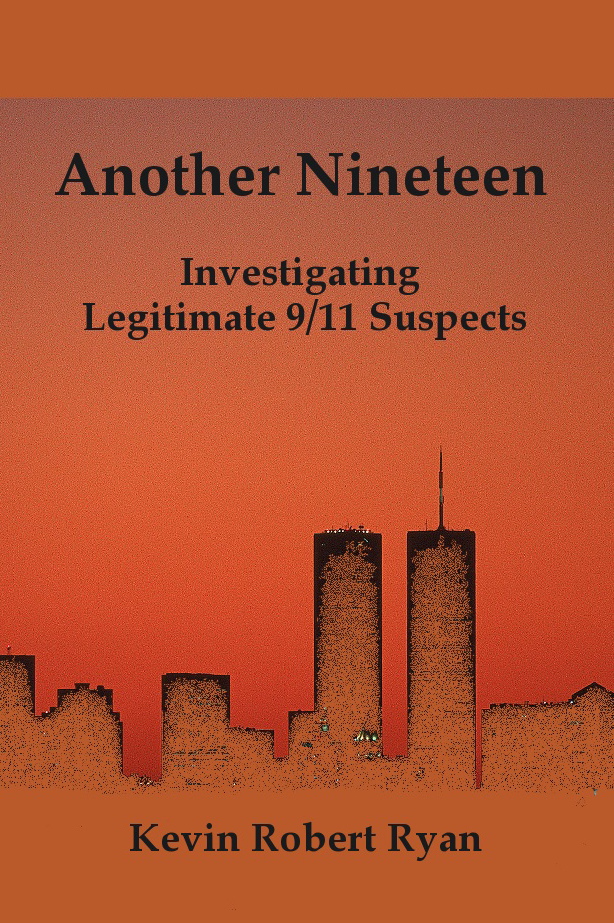
As described in Another Nineteen, Eberhart testified to the U.S. Senate in October 2001 that NORAD had received notification about three of the four hijacked planes with plenty of time to ensure interception and had scrambled jets from multiple bases as the attacks proceeded. Eberhart presented a timeline giving the exact times that the military was notified about the hijackings. He repeatedly told Senators that this was “documented notification.”[14]

However, the 9/11 Commission later told us that all of Eberhart’s statements were untrue. According to the Commission’s account, which exonerated the military, NORAD was not given notification about any of the hijacked flights. And although the Commission claimed that U.S. Air Force officers had knowingly provided false information on these questions, Eberhart was never held accountable.

George Tenet lied extensively about the events surrounding 9/11. He lied to the 9/11 Commission about having met with Bush in the month before the attacks, he lied under oath about CIA foreknowledge of the alleged hijackers, and he lied to the 9/11 Commission by failing to tell them about torture videos that his agency later destroyed. And although Tenet retired in 2004, his protégé John Brennan runs the CIA today and is known for lying to the public about torture and the killing of innocent civilians using drones.

The behavior exhibited by Alexander and Clapper appears to be similar to that of Eberhart and Tenet during the 9/11 investigations. Coupled with Alexander’s role in the Able Danger cover-up, people should wonder if the crimes that the NSA is committing against American citizens today are, in fact, somehow connected to the crimes of 9/11. Not in the sense of preventing terrorism, but in a way that suggests the ongoing implementation of a long-term plan to control the world’s most strategic resources and also the American people.


[1] NSA Director Alexander Admits He Lied about Phone Surveillance Stopping 54 Terror Plots, AllGov.com, Monday, October 07, 2013

[2] Gopal Ratnam, NSA’s Alexander Says Secret Programs Stopped Terror Plots, Bloomberg, June 27, 2013

[3] Jerry Markon and Ellen Nakashima, NSA director says surveillance programs thwarted ‘dozens’ of attacks, The Washington Post, June 12, 2013

[4] NSA Spying Did Not Result In a SINGLE Foiled Terrorist Plot, Washington’s Blog, October 15, 2013

[5] David Sirota, James Clapper is still lying to America, Salon, July  1, 2013

[6] United States v. Usama bin Laden et al., transcript of day 14, March 7, 2001, accessed at Cryptome, http://cryptome.org/usa-v-ubl-14.htm

[7] Kevin Fenton, Disconnecting the Dots: How CIA and FBI officials helped enable 9/11 and evaded government investigations, Trine Day, 2011, p 220

[8] Transcript of Hardball Special Edition, MSNBC, July 24, 2004

[9] Steven Strasser and Craig R. Whitney, ed.s, The 9/11 Investigations: Staff Reports of the 9/11 Commission, PublicAffairs, 2004, p 396

[10] Robert David Steele VIivas, Intelligence for the President–and Everyone Else, Counter Punch, March 1, 2009

[11] Hearing Before the Committee on the Judiciary United States Senate One Hundred Ninth Congress, Able Danger and Intelligence Information Sharing, September 21, 2005, U.S. Government Printing Office

[12] Because providing false testimony to Congress is a crime, these men would be in prison today if the U.S. justice system was still functioning.

[13] Shane Harris reported that Alexander got the NSA job due to Rumsfeld, see his article in Foreign Policy called Profile of NSA Director General Keith Alexander, September 9, 2013

[14] Transcript of Hearing Before the Committee on Armed Services, United States Senate, October 25, 2001, U.S. Government Printing Office

Posted in 9/11 | 9 Comments

Why the NIST WTC Report on the Towers is False

This article first appeared at ReThink911.org.

The official account of the Twin Towers’ destruction was produced by the National Institute of Standards and Technology (NIST) and released in September of 2005. Unfortunately, NIST’s report provided only a hypothesis of the events leading up to the initiation of the collapses, or the “collapse initiation sequence.” NIST did not attempt to explain how, once the collapses initiated, the upper sections of these 110-story skyscrapers would continue falling downward through the path of greatest resistance, instead simply asserting that, once each building was destabilized, “global collapse ensued.” However, we can examine the general features of NIST’s collapse initiation sequence for both Twin Towers to see if it is consistent with known facts, or is at least self-consistent.

The seven steps of NIST’s collapse initiation sequence that are common to both Twin Towers are as follows:[1]

1. A number of columns were severed by aircraft impact

2. Loads were redistributed to the remaining columns

3. Fireproofing was “widely dislodged”

4. Columns and floor assemblies were softened by high temperatures

5. Softened floor assemblies began to sag

6. Sagging floors pulled the exterior columns inward, causing columns to buckle

7. Instability spread around the exterior of the building

The first two steps of this sequence are not surprising. With regard to step one, we can accept that approximately 15% of the columns were severed in each building by aircraft impact. This is quite low compared to original design claims reported in the mid-1960s by the Engineering News-Record that said the towers could lose more than 25% of their columns without having any problems. As for the second step, NIST says the loads actually decreased on some columns and increased slightly for others. Again, there is no problem here considering similar design claims that the exterior columns could withstand 2,000% increases in live load.[2]

finalreport_coverWith step three we get to the core of NIST’s collapse initiation argument. The report states that “The WTC towers likely would not have collapsed under the combined effects of aircraft impact damage and the extensive, multi-floor fires if the thermal insulation had not been widely dislodged or had been only minimally dislodged by aircraft impact.” Considering that NIST depends so heavily on the concept of extensive fireproofing loss, you would think it would have spent a great deal of its time investigating this effect and communicating the details. That was not the case, however.

NIST’s only test for fireproofing loss, never included in the draft reports, involved shooting a total of fifteen rounds from a shotgun at non-representative samples in a plywood box. Flat steel plates were used instead of column samples and no floor deck samples were tested at all. After criticism of the lack of testing provided in its draft report, NIST inserted the results into a 12-page appendix to the final report.[3]

These shotgun tests actually disproved NIST’s findings. One reason is that there is no evidence that a Boeing 767 could transform into any number of shotgun blasts. Nearly 100,000 blasts would be needed based on NIST’s own damage estimates, and these would have to be directed in a very symmetrical fashion to strip the columns and floors from all sides. It is much more likely that the aircraft debris was a distribution of sizes from very large chunks to a few smaller ones, and that it was directed asymmetrically along the path of the impacting airliner. Moreover, there is no indication that fireproofing could have been stripped from beneath the aluminum cladding on the exterior columns, but in subsequent steps of its explanation, NIST depends on this.

NIST’s shotgun tests indicated that 1 MJ of energy was needed per square meter of surface area to shear the fireproofing off. For the areas in question―more than 6,000 square meters of column, floor deck and floor joist surface―the extra energy needed would be several times more than the entire amount of kinetic energy available to begin with. [4]

The problems with NIST’s explanation continue in step four, where high temperatures were said to have softened the columns and floors. NIST did tests for this as well, but then abandoned the results. The first test, which examined paint deformation on steel samples chosen specifically from the fire zones, showed that less than 2% of the samples had seen temperatures above 250 °C. Another test gave the one-sided result that no samples saw temperatures above 600 °C. The obvious problem was that steel does not soften or lose significant strength at the low temperatures indicated, yet NIST’s story depends on the softening or weakening of vast quantities of structural steel.

Fire resistance tests for the steel components used in the Twin Towers were performed by Underwriters Laboratories (UL), at the time of construction, and the results verified conformance to the New York City code requirements for multiple hours of fire resistance at the temperatures expected in a building fire.[5] On 9/11, according to NIST, the fires in the failure zones did not actually last very long. NIST’s estimates indicate that the fires in the failure zones of the towers lasted for only about 45 minutes in each case, much less than the 3 or 4 hours of fire resistance required by the NYC code. [6]

As for step five, UL performed additional tests as part of the NIST investigation in order to establish the fire resistance of models of the WTC floor assemblies. The results were that the floor assembly models not only didn’t collapse, invalidating the longstanding “Pancake Theory,” but the floors barely sagged―only about 3 inches―despite the use of double the known floor load and two hours of fire exposure.[7] NIST then added this 3-inch of sag result to its computer model, and by way of an unknown transformation, it suddenly became 42-inches of extreme sagging.[8] This appears to have been a direct falsification of test results.

Step six says that sagging floors pulled exterior columns inward. To support this, NIST evaluated nine different scenarios within its computer model, with just one of those producing any inward bowing. To do this, NIST had to take a computer mock-up of a 9-story high by 9-column wide section of steel wall and perform manipulations that had no relevance to the events at the World Trade Center. NIST removed the virtual steel from its web of support by “disconnection,” stripped off all the fireproofing, exposed it to twice the known fire time (i.e. 90 minutes), and then applied an unspecified, utterly miraculous inward pull.[9] It is difficult to understand how an inward pull force could be applied to columns that have been disconnected from the floors. It is the floors that are supposed to have applied the inward force on the columns.

NIST’s final collapse initiation step states that, after all of these unscientific manipulations, “instability spread” around the entire building. Since the buildings came down uniformly, and did so in approximately 10 seconds, there was precious little time for instability spread. If we allot half a second to accomplish this, the instability would have had to move at nearly twice the speed of sound. That is, of course, not realistic.

After providing a false collapse initiation sequence, NIST left us to ponder the idea that “global collapse ensued.” With this statement, NIST avoided analyzing the actual collapse dynamics, perhaps because they knew the observed phenomena violated everything we know about physics and the performance of steel skyscrapers, unless the use of explosives is allowed for consideration.


[1] See NIST NCSTAR1, Final Report on the Collapse of the World Trade Center Towers, Principal Findings, 175 (http://wtc.nist.gov/NISTNCSTAR1CollapseofTowers.pdf) and, in more detail, NCSTAR 1-6, Probable Collapse Sequences, p 299 to 309 (http://wtc.nist.gov/NISTNCSTAR1- 6.pdf)

[2] For the original design claims, see “Structures Can Be Beautiful, World’s Tallest Buildings Pose Esthetic and Structural Challenge to John Skilling,” and “How Columns Will Be Designed for 110-Story Buildings,” Engineering News-Record, April 2, 1964. The exact comments were that “live loads on these [perimeter] columns can be increased more than 2000% before failure occurs” and “one could cut away all the first-story columns on one side of the building, and part way from the corners of the perpendicular sides, and the building could still withstand design live loads and a 100-mph wind force from any direction.”

[3] See NIST NCSTAR 1-6A, Appendix C, http://wtc.nist.gov/NISTNCSTAR1-6A.pdf

[4] NIST gave 2,500 MJ as the kinetic energy provided by the aircraft impacting the north tower. Professor Tomasz Wierzbicki from MIT, in a report called Aircraft Impact Damage, calculated that all of this energy was consumed in damaging the aircraft and the building, with no energy remaining.

[5] See Kevin Ryan, Propping Up the War on Terror: Lies About the WTC by NIST and Underwriters Laboratories, in David Ray Griffin and Peter Dale Scott, eds., 9/11 and American Empire: Intellectuals Speak Out (Northampton, Mass.: Interlink Books, Fall 2006).

[6] In NCSTAR 1-6, section 9.4.3 (p 322) and section 10.9.4 (p 338), NIST says “The fires in WTC 2 reached the east side of the building more quickly, within 10 to 20 minutes, than the 50 to 60 minutes it took the fires in WTC 1 to reach the south side.” http://wtc.nist.gov/oct05NCSTAR1-6index.htm In both cases, this would leave approximately 45 minutes of fire time in the failure zone.

[7] In NCSTAR 1-6, it says “…four standard fire resistance tests (ASTM E119) of the floor truss assemblies with twice the floor load that was on the WTC floors.” Chapter 10, p 332, Finding 17.

[8] The extent of the floor deck sagging after the unrealistic time of two hours can be seen in NCSTAR 1-6 Figure 3-11 (p 49). The 3-inch result is visible there or, based on the 45-minute duration of fires in the failure zones, it can be seen in the graph of Figure 3-15 (p 52). The unsupported computer result of 42-inches of sagging is noted in the same report, Chapter 9, Figure 9-6 (p 297).

[9] NIST’s Case 8, the “DBARE” result, was finally successful at causing inward bowing of a highly manipulated computer mock-up. It is described in NCSTAR 1-6, Chapter 4, tables 41-14 and 4-15 and pages 111 to 115.

Posted in 9/11 | 16 Comments

Zombies Needed for Drone Terror

This article was first posted at Washington’s Blog.

The U.S. Air Force is complaining that it cannot find enough drone pilots. Of course, there are plenty of kids with the video gaming skills needed but, for one reason or another, they just won’t sign-up fast enough. The reasons might have to do with less promotional opportunities in the drone program but it could also be that many of these kids simply don’t want to engage in cowardly acts of long-distance killing. In any case, they need some convincing because the drone wars are just firing up.

The military and corporate media have gone into overdrive in order to improve perceptions about the U.S. drone program and put drone attacks in a better light. And some of the verbiage suggests that it is not just general public opinion that is the target, but perhaps more importantly the opinion of potential drone pilot recruits. Drone pilots are redefined as “sensor operators” and the drone industry is campaigning to eliminate the word drone. And the Air Force has turned to using video games, referred to as “militainment,” to recruit drone pilots.

In early 2012, the Bureau of Investigative Journalism reported on the military’s use of a drone technique called the “double tap.” This is where a drone attack occurs and then, moments later, the first responders who arrive at the scene to rescue the victims are hit with another drone attack. There is evidence of 11 strikes on rescuers between 2009 and 2011 as well as a deliberate attack on a funeral causing mass casualties. The double tap technique continues to this day.

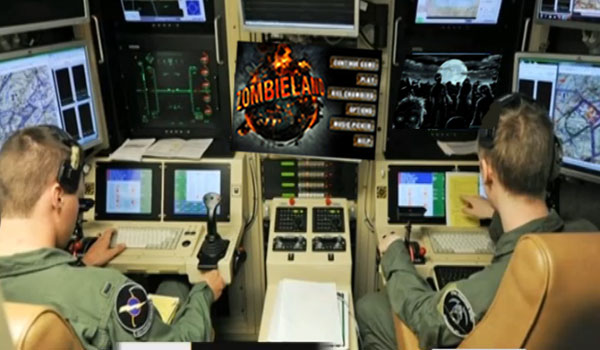
drone-kids2Kids will quickly recognize the better-known use of the term double tap. It is one of the rules from the popular movie Zombieland, also made into a video game. The movie is based on the adventures of a young man as he navigates through a zombie apocalypse. He learns to rely on certain rules of survival and double tap—to shoot any zombie twice even if it looks dead—is one of the rules. Other rules include shoot first, enjoy the little things, and don’t be a hero, all of which apply to the prospective drone pilot.

Killing zombies can be cool in a movie, and the kids who are recruited by the military these days know all about that. The drone attacks practiced by the U.S. military, however, are gruesome obliterations of actual human life and that is readily apparent to the families of the thousands of drone victims around the world. In the real-life scenario, the victims are not zombies. Instead, it is the drone pilot who must suppress all human emotion and thought about the victims. In other words, it’s the drone pilot who becomes a zombie.

The CIA and the military, including the secretive Joint Special Operations Command, kill people with drones every day in the borderless and ill-defined War on Terror. Drone strikes occur regularly in countries like Afghanistan, Pakistan, Somalia, and Yemen. And the attempts to make these attacks sound cool or righteous are coupled with dehumanization of the victims. Preferably, the victims can be described as militants but, if not, the generic term combatants must serve. Since combatants are defined as any male of military age, in practice that means almost anybody.

First responders and funeral participants are obviously not acceptable targets in any kind of war. But we need only vaguely hear that drone victims might have been “linked” to potential terrorists, or in the vicinity of potential terrorists. The U.S. Justice Department has concluded that government leaders can order the drone killing of anyone, even American citizens, if they are believed to be “senior operational leaders” of Al-Qaeda or “an associated force.” If all else fails, they are simply called Arabs.  Of course, it is difficult to not hit an Arab in the countries where drones operate.

The problem with de-humanizing the victims is that they are known to be real people living and struggling in their own land, being attacked by young foreigners playing video games seven to ten thousand miles away. For the political purposes behind the drone program, we need the victims to somehow become less human or more recognizable as fair targets in legitimate conflicts, and we need drone pilots to be seen as more heroic. To that end, we now have zombie reporters to tell us how our normal feelings of moral outrage about drone killings can be alleviated.

An example of zombie reporting has recently been found in The Atlantic.  Reporter Mark Bowden wrote an article telling us “How to think about drones.” Bowden explained that we are at war, and “the last thing you want is a fair fight.” He went on to explain how a drone pilot suffers anxiety and therefore, in so many words, should be considered a brave and indispensible soldier in the War on Terror.

Bowden lauds CIA Director John Brennan who leads the drone terror effort in Pakistan and Yemen. To address criticism of the effort, Bowden wrote, “John Brennan has argued that claims of collateral carnage are exaggerated“ and that “local press accounts from many of the blast sites have reported dead women and children. Some of that may be propaganda.” Bowden goes on to explain that, “At one extreme, anti-American propagandists regularly publish estimates that make the drone war sound borderline genocidal. These high numbers help drive the anti-drone narrative, which equates actions of the U.S. government with acts of terror.”

Yes, drone bombing civilians around the world certainly does seem like terror. But what Bowden appears to be arguing is that drone attacks are not really terror unless you can document that enough women, children, rescuers, and funeral participants have been killed. If so, we can safely count Bowden among the soul-less, walking dead.

That justification of drone terror was followed-up a week later at The Atlantic with another article by Michael W. Lewis, who attempted to explain how drone attacks are actually “the most humane form of warfare ever.” Lewis reminded us that “all armed conflicts cause civilian casualties” and that Afghanistan leader Hamid Karzai was not bothered by the attacks, which “did not cause him or the Afghan people any appreciable concern.”

These attempts by media sources to make us feel better about drone attacks are absurd and imply that the target audience may have already suffered the kind of mental death attributed to zombies. Those of us who have not yet succumbed to propaganda-induced brain death realize that it is the military and the corporate media who have become non-human. We can see that the real zombies are not just the kids at the joysticks of death but we are witnessing zombie reporting too, employed to frame the attacks for zombie-like citizens.

Forty years ago, Americans were outraged by the revelations of the CIA’s “family jewels”—crimes against democracy that the CIA was secretly perpetrating around the world. But many of those Americans are now gone and their descendants have quietly come to accept more state crimes than might ever have been imagined back then. Multiple wars of aggression, indefinite detention of suspects without charges, secret CIA torture sites around the world, and spying on all Americans are undeniable offenses of our government that have been agreed to by the corporate media and, by default, the public. Drone terror is just the next step.

As these attempts at zombification of our society expand, more and more young people raised on violent video games will be recruited to engage in the long-distance killing of people around the world. Yet even the fact that tens of thousands of drones are being manufactured for use within the United States is unlikely to raise an alert with a public that has been carefully prepared for reports of drone killings and presidential “kill lists.” When drone terror begins to occur on U.S. soil, perhaps even double taps that kill first responders, will it result in any outcry or will our fellow citizens be sufficiently zombiefied by then?

This September is the twelfth anniversary of the origin of the War on Terror. Perhaps it is finally time for the American public to re-animate the corpse of its political will, through enlightened self-interest, and call for a little critical thinking if not a moral uprising.

Posted in 9/11 | 5 Comments

Political Warfare and the 9/11 Commission

When the 9/11 Commission Report was published in July 2004, it provided a completely new explanation for why the U.S. air defenses had failed to intercept any of the four hijacked planes on 9/11. Certain 9/11 Commission staff members had helped to produce that new story, and at least one of them was behind earlier explanations that were contradicted by the new account. That was Miles Kara, a retired U.S. Army intelligence officer. Kara has since been working via his blog and his personal contacts to persuade those questioning the official account that the unanswered questions of 9/11 are often just minor misunderstandings or are simply unimportant.

As a member of the 9/11 Working Group of Bloomington, I was first contacted by Kara in October 2009.[1] Since that time, Kara has taken a keen interest in several articles published at the Journal of 9/11 Studies. He has written to me about those articles as they were published. Kara’s input is always critical and focused on supporting the official account.

Kara’s behavior in downplaying the unanswered questions of 9/11, while providing conflicting accounts over time, is reminiscent of the approach taken by the 9/11 Commission. Author David Ray Griffin offered an analogy for that approach.

Normally, when a suspect in a criminal investigation keeps changing his story, we get suspicious. Let’s say that the police ask Charlie Jones where he was Saturday night. He says he was at the movie theater, but they say, “No, the movie theater has been closed all week.” Then Charlie says, “Oh, that’s right, I was with my girl friend.” But, the police say, “No, we checked with her and she was home with her husband.” If at that point Charlie says, “Oh, now I remember, I was home reading my Bible,” you are probably not going to believe him. And yet that’s what we have here. The military told one story right after 9/11, another story a week later, and a third story through The 9/11 Commission Report in 2004.[2]

As I point out in my book Another Nineteen, the military actually gave four distinct stories for how it failed to respond to the hijacked aircraft. Therefore if Charlie’s mother said Charlie was an atheist and therefore did not read the Bible, and Charlie gave yet another excuse, the analogy would be more fitting.

Kara behaves much like Charlie. As problems with the official account of the air defense failures are presented, Kara offers a seemingly endless stream of possibilities to prop up the official account. At his blog Kara suggests that the air defense failures may ultimately be understood only through Chaos Theory.[3] The way Kara applies Chaos Theory is not like the expected situation in which sensitive dependence on initial conditions makes small errors balloon into a major catastrophes. It’s more of an exercise in throwing vast amounts of random comments and data at a question in the hope that the questioners will become confused (experience chaos) and make the error of giving up.

In any case, sometimes it’s best to learn more about a person’s history in order to get a better handle on their motives. That seems to be the case with intelligence officer Miles Kara.

As one of 53 staff members who worked for the 9/11 Commission, Kara was in an interesting group. Like Kara, a quarter of those staff members were associated with the U.S. intelligence community. Another quarter had been employees of the FBI’s parent organization – the Department of Justice. Several were responsible for counterterrorism prior to 9/11. The remaining staff members were employees of the private companies Citigroup, CSIS, the RAND Corporation, and SAIC, or were lawyers from intelligence-related firms like Sullivan and Cromwell.

Having joined the earlier Joint Inquiry, in May 2002, directly from the Defense Department’s Inspector General Office of Intelligence Review, Kara went on to play a large role in producing the 9/11 Commission’s account of the air defense failures. He was present at a majority of the interviews of witnesses and he wrote many of the summary reports. Emails and other documents released by the 9/11 Commission suggest that Kara was a significant leader in the investigation and in the drafting of the Report.

Prior to working on the 9/11 investigations, Kara had spent ten years in the DOD Inspector General’s office. That office was responsible for investigating government misconduct of various kinds and producing reports that let the government and the military off the hook. A major investigation at the time was that of the Navy’s Tailhook Scandal, and one of the sexual deviants who escaped accountability in that scandal was future 9/11 Commission member John Lehman. Kara’s resume shows that he worked on about a dozen other investigations although only one addressed terrorism and only one involved aviation. What these investigations all had in common is that they exonerated the government or military from suspected wrongdoing.

In the 1980s, Kara worked for the Intelligence Center at U.S. Pacific Command. While there he supervised Michael Kuhn, who was one of two lead analysts on the Iran-Iraq War. During this time, the U.S. was engaged in a massive propaganda operation in the region, and seemed to be playing both sides of the conflict with the intent of weakening both Iraq and Iran. Kuhn went on to become the intelligence chief for NORAD and U.S. Space Command at the time of the 9/11 attacks and he was later a witness for the Joint Inquiry into 9/11. Kuhn was also of interest to the 9/11 Commission because Lt. Col. Stuart of NEADs had testified that Kuhn was one of the people whom he had briefed, before 9/11, about the scenarios in which terrorists would fly aircraft into buildings.[4]
political-warfareBefore working with Kuhn on the Iran-Iraq War program, Kara had written a book on Political Warfare for the U.S. Navy. Political Warfare is defined as “propaganda and psychological operations (PSYOP), which service national and military objectives respectively.”[5] Kara was seen as an expert on such things and had spent six years (1974-1980) as a Political Warfare instructor at the Navy’s Amphibious School, Coronado. He taught the two-week course at least ten times a year.

Before teaching political warfare, Kara was a U.S. counterintelligence specialist in Southeast Asia. In 1969, he was a Detachment Commander for the 525th Military Intelligence Group in Vietnam. At the time, the 525th was involved in providing support to the CIA’s massive counterterrorism (meaning terrorism) and assassination project called the Phoenix Program.[6] Kara went on to be responsible for world-wide “counterintelligence services.”[7]

His career details indicate that Kara was not an expert on air defenses, but was in fact an expert on propaganda related to suspected government misconduct and terrorism. That possibility was emphasized by the fact that, while Kara was teaching his Political Warfare course, he brought in terror propagandist Brian Michael Jenkins to help.[8]

Jenkins is known as a RAND Corporation executive but, in the 1990s as the Deputy Chairman of Kroll Associates, he had designed the security system for the World Trade Center. His history as a special operations soldier and long-time right-wing political advisor contributed to criticism of his role at the WTC. Not long after the 1993 bombing it was reported that Jenkins was “trotted out” to explain the threat we faced. Described as one of the hoariest holdovers from the era of Reagan ‘roll, back,’ RAND’s Brian Jenkins was both an apologist for and one of the architects of the contra war against Nicaragua–a terror war aimed primarily at the civilian population and infrastructure.”[9]

One of the 9/11 suspects examined in Another Nineteen, Jenkins played a leading role in planning for future terrorist events at the WTC, including having reviewed the possibility of airliner crashes into the towers. Coupled with the claims that he participated in planning and implementing a “terror war” in Central America during the 1980s, these facts should make him a subject of considerable examination with respect to 9/11.

During the government’s 9/11 inquiries, Kara never mentioned having worked with the man who led the design of the WTC security system. But he did note his relationship to NORAD intelligence leader Kuhn. Nonetheless, he was chosen to help lead the 9/11 Commission investigation.

Under Kara’s guidance, the 9/11 Commission Report provided the military’s fourth account of the air defense failures. This said that NORAD had only “nine minutes’ notice on the first hijacked aircraft, no advance notice on the second, no advance notice on the third, and no advance notice on the fourth.”[10]

This official account of the NORAD notifications is in glaring contrast to the earlier timelines provided by NORAD personnel. And it appears that Kara was personally behind the false testimony of U.S. Air Force General McKinley and his subordinates when they provided one of those completely different timelines in May 2003. As General McKinley stated to the 9/11 Commission at that time:

McKinley: “I’d like to thank the Commission staff, especially Miles Kara, for his help in preparing for this. Our intention is to provide the chronology first to the events leading up to September 11th, as well as taking your questions to give you a detailed look at how NORAD’s response was made on 9/11.”[11]

McKinley deferred to his subordinate Colonel William Alan Scott to provide much of the timeline that had been prepared. Scott clarified that the times given in each case might have been a little later than the actual times due to allowance for communications and recording of the events.

Scott: “I will tell you the times on this chart come from our logs. The time on the chart is the time that’s in the log. It may not be the exact time the event happened. It may be the time when the log-keeper was advised or became aware of the event.”

Scott: “[At] 9:16, now FAA reports a possible hijack of United Flight 93, which is out in the Ohio area.” [12]

Scott: “At 9:24 the FAA reports a possible hijack of 77. That’s sometime after they had been tracking this primary target. At 9:25, America 77 is reported headed towards Washington, D.C., not exactly precise information, just general information across the chat logs.”

Scott: “And 9:40, immediately following that, is when 93 up north turns its transponders off out in the West toward Ohio, and begins a left turn back toward the East.”

General Larry Arnold, who was in charge of the First Air Force on 9/11, helped McKinley provide the (apparently) false account in this May 2003 hearing. Arnold said, “Our focus was on United 93, which was being pointed out to us very aggressively I might say by the FAA.” As Commissioner John Lehman began his questioning, Arnold elaborated on this account.

Arnold: “It was our intent to intercept United Flight 93. And in fact my own staff, we were orbiting now over Washington, D.C. by this time, and I was personally anxious to see what 93 was going to do, and our intent was to intercept it. But we decided to stay over Washington, D.C., because there was not that urgency.”

We might wonder why the General in charge of defense of the air space in the Continental United States did not feel a sense of urgency when dealing with the fourth hijacked plane on 9/11. Regardless, General McKinley went on to say, “This is the best and most accurate data that we could piece together for your Commission.” Given this account, which was prepared with the help of Miles Kara, NORAD was given 14 minutes notice on the third plane and at least 47 minutes of notice on the fourth plane, which it was tracking. Unfortunately, NORAD’s best and most accurate data directly and repeatedly contradicted the 9/11 Commission Report.

In order to reconcile the conflicting accounts, Kara’s Commission colleagues suggested that the military leaders had been lying. In a memorandum summarizing these concerns, Philip Zelikow claimed that,

“Team 8 has found evidence suggesting that one, or more, USAF officers – and possibly FAA officials – must have known their version was false, before and after it was briefed to and relied upon by the White House, presented to the nation, and presented to us at our May 2003 hearing.”[13]

It is interesting that Kara was not questioned about that false version, given that the USAF officers had thanked him for helping them to prepare it. However, apart from the fact that none of these people were held accountable, this claim of deception presented a paradox that Zelikow, Kara, and their colleagues did not address. It suggested that NORAD leaders had crafted elaborate lies and repeated them for years in order to make their own organization look bad. But it doesn’t take a Political Warfare specialist to realize that it is more likely they are lying now, along with the 9/11 Commission, in order to remove NORAD’s responsibility and eliminate questioning about 9/11.

Given the multiple explanations provided by the military for the lack of air defenses on 9/11, independent researchers should avoid accepting new answers or excuses uncritically. And considering the history of Miles Kara, including his past in teaching Political Warfare, independent researchers should be cautious about his intentions when he approaches them. For example, the treatment of NORAD’s 9/11 exercises suggests that some investigators implicitly accept Kara’s vague claims that the simulated “injects” were never made. However, these claims are in direct contradiction to other evidence including that NEADS responders testified to being confused by the exercise and that NORAD’s Cheyenne Mountain Operations Center had to specifically asked NEADs to stop the simulated injects long after they had begun.[14]

No one has been behind the false accounts of the 9/11 air defenses more than Miles Kara, who was a leader for the Commission’s Team 8 and who was both a witness and a staff member for the Joint Congressional Inquiry into 9/11. It appears that Kara continues to obfuscate the facts and support whatever information might prop up the official account of 9/11. Given this, and realizing Kara’s background in Political Warfare, it would seem wise to keep his ongoing input in perspective.


[1] For the letter sent to the Bloomington group and the responses to it, see Kara’s blog. http://www.oredigger61.org/?cat=25

[2] David Ray Griffin, 9/11: The Myth and the Reality, 911Truth.org, April 5, 2006, http://www.911truth.org/article.php?story=20060405112622982

[3] See Kara’s blog, 9-11 Revisited, http://www.oredigger61.org/

[4] 9/11 Commission Memorandum for the Record, Interview of Lt. Col. Mark E. Stuart, October 30, 2003, prepared by Miles Kara

[5] Wikipedia page for Political Warfare

[6] See Kara’s resume and Douglas Valentines book, The Phoenix Program.

[7] See Kara’s resume submitted to the 9/11 Commission

[8] See Kara’s discussion of the course and Jenkins here: http://council.smallwarsjournal.com/archive/index.php/t-7375.html

[9] Gerry O’Sullivan, Boom! – World Trade Center bombing – Column, Humanist, May-June, 1993 issue, http://findarticles.com/p/articles/mi_m1374/is_n3_v53/ai_13818521/

[10] The 9/11 Commission Report, p 31

[11] 9/11 Commission Hearing, Day 2, Civil Aviation Security, May 23, 2003

[12] Note that Flight 93 could not have been confused with Delta 1989 which was also being tracked and had landed in Cleveland by 9:47 according to NORAD logs. Moreover, General Arnold made clear, in an interview with 1st Air Force public relations writer Leslie Filson, that NORAD was tracking both United 93 and Delta 1989. Filson also clarified that she was told that they were tracking United 93 specifically. Since NORAD was aware of both, it could not be that Delta 1989 was mistaken for United 93.

[13] Memorandum from Philip Zelikow to Thomas Kean and Lee Hamilton entitled “How Should the Commission Handle Evidence of Possible False Statements by US Officials,” dated June 6, 2004.

[14] See my article The Case Against Ralph Eberhart and Kara’s response to that article at his blog: http://www.oredigger61.org/?p=6014. Also note that Kevin Naspany was not in charge of the exercises, Lt. Col. Neil Cleveland was.

Posted in 9/11, 9/11 Suspects | 13 Comments

Conversation with UK professor

A professor from the University of Kentucky recently contacted me with the intent of gathering information for her upcoming course: “(UKC 381) Deliberation, Persuasion, and Bullshit in the Public Sphere.”   Here are her questions and my answers.

jenny rice“As a scholar of public discourse and argumentation, my research is all about how people conduct their own research into complicated issues. I am also interested in what you find persuasive and what you find unbelievable. These questions aren’t so much about the specific topics you research. Instead, I’m more interested in hearing all about your habits as a researcher. I follow your 9/11 research, and I’ve seen the extensive work you’ve done, so I wanted to follow up with you.”

(1) How long have you been participating in conversations about “alternative knowledge” or skepticism?

I’m not exactly sure what you mean by alternative knowledge.  For that reason, I’ll answer using a variation of a definition for another term I’ve used recently.  Alternative knowledge would then be facts that are “systematically ignored or falsified in the mainstream media and public consciousness.”  If that is the definition, I have been involved in discussing such things, particularly related to the crimes of 9/11, since 2003.

(2) How important is it to organize the research you find about the topics you care about? Why? Do you have any kind of system to keep track of the information you find?

The information I learn about 9/11 is organized in a number of ways.  One way is through the articles and blog entries that I write, and another is through the Journal of 9/11 Studies where I’m co-editor. When doing research for an article or a book, I use a number of tools to preserve the information.  It is important to document and save what is learned, so that it can be referred to in the future.

(3) If you do have a system for organizing this information, can you describe it?

I don’t use a formal system to save information but I do use different techniques depending on where I am and the nature of the source material.  When reading books, I’ll flag or dog ear pages and sometimes take detailed notes on paper which are kept with the book. With articles, I’ll sometimes print them out and highlight the important points and save them as hard copies.  Other times, I’ll take notes electronically and save them as Word docs or draft emails.  When interviewing people, I try to record the conversation.

(4) Can you tell me about any writers or speakers whose work you admire? This might be someone you find very persuasive. What makes these people (or this person) persuasive or appealing to you? (These could be current people or historical writers.)

With regard to 9/11 and other deep state events, I admire the work of people like Peter Dale Scott, David Ray Griffin, and Joseph Trento.  Professor Scott is good because he is careful and uses many good references.  He will make inferences from data but not inferences from inferences.  Trento is a journalist and bases a lot of his work on personal interviews.

(5) When talking or writing about 9/11 issues, how would you describe your own argumentative style? Do you argue differently with people you agree with than with people you disagree with?

I don’t argue directly with others much but I have been involved in a few debates on the topic of 9/11. These were with people who practiced bullshit. That is, they “systematically ignored or falsified” the facts as they argued in support of the current official account of 9/11 (i.e. those accounts changed over the years) no matter what was said. One example was a debate on Air America radio with alleged skeptic Michael Shermer. I wrote about that experience in this article. Another instance was on NPR for a show about 9/11 skeptics. As the only 9/11 skeptic on the show, I was given 5 minutes to answer leading questions. The remaining 45 minutes were taken up by the substitute host and two bullshitters who used some variant of the term “conspiracy theorist” every 30 seconds. I was able to get a more fair treatment with one of those people on Pacifica (KPFA) radio a month later.

I’m not certain what you mean by arguing with people you agree with. With honest people who disagree, my approach is to stick with facts and try to find common ground. An example is Noam Chomsky, who I’ve found through email exchanges to be open-minded and very intelligent. We seem to have similar long-term goals yet we have different viewpoints on 9/11. I believe that part of the reason for the difference is that Noam has already made too many public claims about 9/11 to rethink much of it in any significant way. That leaves us with an inability to agree completely. For example, he agrees that explosives might have been used at the WTC but that, if so, it would have had to be Saddam Hussein or OBL who made it so.

(6) What do you think is the key to being persuasive in conversations about complicated issues, such as 9/11 events?

When writing or talking about 9/11, it is important to maintain a sense of compassion and speak to all those listening, many of whom are often silent but still attentive.  In order to reach people on 9/11, we must remember that the facts are the easy part. The emotional barriers are what require work to overcome.  It’s important to remind listeners and readers that 9/11 was the origin of the War on Terror.  People are still dying every day because of the false official accounts of 9/11. What else have we invested in those false accounts?  By examining the answers to that question honestly, it is possible to appeal to what can be called enlightened self-interest.

(7) Have you had any exchanges online or in person that question your own claims on this topic? How do you respond?

Yes, of course. Both online and in person. The response depends on the situation.

(8) Do you remember how you’ve learned how to make claims and arguments? What do you remember from school? Did those lessons seem to be helpful when participating in this alternative knowledge community?

I was never on the debate team. For me, arguments are only worthwhile if there is something important that needs to be done, like learning about what happened on 9/11 so that the knowledge can drive positive change in society.  My last English composition class was at Purdue in 1981.  I found that helpful in terms of framing ideas and maybe a little helpful in learning to persuade.  Also useful has been a book by William Zinsser called On Writing Well.  When dealing with bullshitters, I’ve found it helpful to understand Schopenhauer’s techniques for debate.  I don’t use those (bullshit) techniques, but it is good to understand when they are being used.

(9) What makes other people’s arguments sound persuasive or unpersuasive to you?

Anger, ad-hominem attacks, appeals to authority, and baseless speculation make arguments poor.  Facts backed by references given in a logical sequence, and a thoughtful, compassionate approach, make for good listening and open minds.

(10) Have you ever heard someone make an argument that sound convincing, even though you disagree with him/her? If you can think of an example, can you describe it?

With regard to 9/11, I can imagine the convincing argument that I would disagree with. And although I have not heard it uttered publicly yet, I expect that argument to be used and accepted in the future.  That argument is that the geopolitical and economic environment at the time of 9/11 required Western leaders to make a choice between a) killing a few thousand people in order to provide a pretext for the seizure of resources, or b) allowing events to take their course without those resources being seized. In other words, kill a few thousand now or watch millions suffer through changes of unprecedented scope. I disagree with that argument because I think there were other alternatives. But maybe I’m just an idealist.

(11) Have you always enjoyed researching, even before you became involved in the “alternative knowledge” community? Why or why not?

I’ve always enjoyed reading, writing, and critical thinking but did not become involved in any significant research until after I began studying the events of 9/11.

I’ll be interested to see how she uses this kind of input for her course.

Posted in 9/11 | 10 Comments

New Book Reveals 9/11 Suspects

The U.S. government has turned to 9/11 again in order to justify its program of spying on all Americans and to support a new, expanded war in Syria. Yet as Americans are distracted by these ongoing crimes, the deception behind the origin of the War on Terror is being more fully revealed.

Cover2CWere the crimes of September 11, 2001 solely the work of Osama bin Laden and nineteen troubled young Arabs, or were more powerful people involved? After a decade of investigation Kevin Ryan, the co-editor of the Journal of 9/11 Studies, offers an evidence-based analysis of nineteen other suspects.

With the support of victim’s families and leading 9/11 researchers, Another Nineteen looks at who was in position to accomplish major elements of the crimes that have yet be explained. Detailed evidence is presented that reveals how each of the alternative suspects had the means, motive and opportunity to accomplish one or more aspects of the 9/11 attacks.

 “Finally a comprehensive and meticulously researched book that thoroughly details what occurred before and on 9/11. Without a doubt, Another Nineteen should be required reading for those who want the real story.” – Robert McIlvaine, father of Bobby McIlvaine, who was killed at the World Trade Center on 9/11

“Kevin Ryan has written a book that reminds us that the attacks of September 11, 2001 and their details have never really been investigated. Kevin has laid out the historical framework in a way that has never been done before. The importance of this cannot be overstated.” – Lorie Van Auken, member of the Family Steering Committee for the 9/11 Commission and widow of Kenneth Van Auken, who was killed at the World Trade Center

Starting with what should have happened that did not, and what should not have happened that did, Another Nineteen reveals that certain powerful people had the means, motive and opportunity to make 9/11 happen exactly as it did. Those people represented private networks and government programs that came together in surprising ways on 9/11.

To get the book, go to the secure E-store: https://www.createspace.com/4289114

Or go to Amazon for a considerable discount.

For more information and updates, visit http://www.another19.com.

Posted in 9/11 | 16 Comments

Another FBI-facilitated attack?

As the Boston Marathon bombing continues to dominate the news, several characteristic responses to terrorism are becoming obvious once again.  To begin with, reports of terrorist acts in America have become like the throwing of a mental switch that stops people from thinking.  Emotion is high and critical thought is rare in the midst of the initial media frenzy.  Propaganda has made it easy for people to fear and hate while forgetting facts about the government’s role in terrorism and its tendency to benefit from terrorist acts.  Additionally, the Boston incident has shown again how official accounts of terrorist events tend to change dramatically as time passes.

Immediately after the attacks, the entire city of Boston, an icon of independence and freedom since the American Revolution, was locked down in a frantic search for one scared teenage boy.  The suddenly “infantilized” public responded by accepting an unprecedented police-state occupation of the city.[1]  The mainstream media did not question any of these obviously anti-American actions and reported only the sensationalist viewpoint of the government “protectors.”[2]

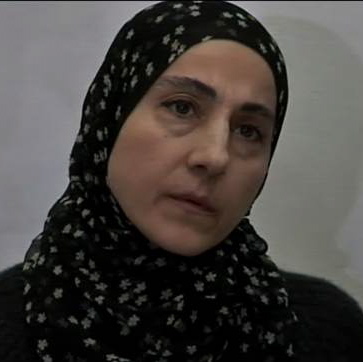
The Boston story began to change quickly, however.  For example, just days after the bombing, the mother of the two suspects made some startling remarks about her son’s relationship to the FBI.

Mother“He (Tamerlan) was ‘controlled’ by the FBI, like, for three to five years,” she said, “They knew what my son was doing.  How could this happen?…They were controlling every step of him, and they are telling today that this is a terrorist attack,” she added.[3]

Although surprising, these claims agree with facts known about FBI-sponsored terrorist acts that have played out in the last decade.    In 2011, journalist Glenn Greenwald reported that the cases in which the FBI had supposedly stopped terrorist plots were actually instances of the FBI itself plotting the terrorist acts and entrapping the young suspects.

“None of these cases entail the FBI’s learning of an actual plot and then infiltrating it to stop it.  They all involve the FBI’s purposely seeking out Muslims (typically young and impressionable ones) whom they think harbor animosity toward the U.S. and who therefore can be induced to launch an attack despite having never taken even a single step toward doing so before the FBI targeted them.  Each time the FBI announces it has disrupted its own plot, press coverage is predictably hysterical (new Homegrown Terrorist caught!), fear levels predictably rise, and new security measures are often implemented in response.”[4]

The 1993 WTC bombing was also a case of suspicious FBI activities gone wrong.  As the New York Times reported, it was clear that the FBI was somehow involved in the WTC plot.

“Law-enforcement officials were told that terrorists were building a bomb that was eventually used to blow up the World Trade Center, and they planned to thwart the plotters by secretly substituting harmless powder for the explosives, an informer said after the blast.  The informer was to have helped the plotters build the bomb and supply the fake powder, but the plan was called off by an F.B.I. supervisor who had other ideas about how the informer, Emad A. Salem, should be used, the informer said.”[5]

In the years leading up to 9/11, the FBI failed miserably at preventing terrorism when preventing terrorism was the FBI’s primary goal.  Moreover, the actions of FBI management suggest that it was facilitating and covering-up acts of terrorism.  When 9/11 happened, some agents accused their own agency of being responsible.[6]

Therefore it is not surprising that the mother of the Boston bombers, who declared that the Bureau had been controlling her son, was labeled as a terrorist suspect just a week after her accusations against the FBI.[7]  Supposedly, the CIA had put her name in its terrorism database months before her sons’ actions in Boston.  This was followed up more recently by vague claims from “U.S. officials” that the mother was recorded by Russian authorities speaking to her son about “the idea of jihad.”[8]  Although these late claims appear to be a matter of the government declaring an unwanted witness to be untrustworthy, the growing myth of the Boston bombing raises a number of interesting questions.

  • What could the mother have possibly gained from offering up her two sons as fodder for the terrorism-industrial complex?
  • Why didn’t the FBI and CIA immediately report that the mother was a terrorism suspect, instead of waiting two weeks and saying something only after the mother had publicly made accusations against the FBI?
  • Why haven’t the mother’s claims with regard to the FBI controlling her sons been investigated by independent reporters in the U.S. mainstream media?
  • How does this case relate to reports that the “underwear bomber” was working for the CIA?[9]
  • Will the media follow-up on the recent revelations that the Boston suspects were related to a top CIA official?[10]

The U.S. government has fostered and benefited from a fear of terrorism since 9/11.  Realizing this, citizens would do well to remember how quickly their freedoms can be lost in the uproar over even a single, relatively low impact terrorist incident.  The Boston Marathon bombing has reminded us that freedom comes at the price of eternal vigilance.  Of course, it doesn’t hurt to have the ability to control one’s emotional responses and temper the reactions of others.  When the next attack occurs, and as the official account of this incident evolves, people should watch for similarities with the accounts of other terrorist events and question everything they are being told.

[1] John Kirby, Infantilized Americans made to ‘shelter in place’, Providence Journal, April 21, 2013, http://blogs.providencejournal.com/ri-talks/this-new-england/2013/04/xxx-4.html

[2] James Corbett, The War On Terror Is Over. America Lost., CorbettReport, http://www.youtube.com/watch?v=aK2w_FdHYV8

[3] Grace Wyler, Mother Of Boston Bombing Suspects Says FBI Was In Contact With Her Son, Business Insider, April 19, 2013, http://www.businessinsider.com/tsarnaev-brothers-mother-fbi-boston-bombing-2013-4#ixzz2RldCqAPv

[4] Glenn Greenwald, The FBI again thwarts its own Terror plot, Salon, September 29, 2011, http://www.salon.com/2011/09/29/fbi_terror/

[5] Ralph Blumenthal, “Tapes Depict Proposal to Thwart Bomb Used in Trade Center Blast,” New York Times, October 28, 1993

[6] Kevin R. Ryan, Why Louis Freeh Should Be Investigated For 9/11, DigWithin.Net, November 21, 2012, https://digwithin.net/2012/11/21/louis-freeh/

[7] Daily Mail Online, Revealed: Mother of Boston ‘bombers’ was put on CIA terrorist watchlist 18 months before attacks and is now a ‘person of interest’, April 26, 2013, http://www.dailymail.co.uk/news/article-2315440/Boston-bombers-mother-CIA-terrorist-watchlist-18-months-attacks-person-interest.html#ixzz2RllkLYZs

[8] Kim Murphy and Ken Dilanian, Russians monitored calls of Boston suspect’s mother, U.S. says, The Los Angeles Times, April 28, 2013, http://www.latimes.com/news/nationworld/nation/la-na-boston-bombings-20130428,0,5275223.story

[9] Paul Harris and Ed Pilkington, ‘Underwear bomber’ was working for the CIA, The Guardian, May 8, 2012, http://www.guardian.co.uk/world/2012/may/09/underwear-bomber-working-for-cia

[10] Sibel Edmonds, BFP BREAKING NEWS: Boston Terror, CIA’s Graham Fuller & NATO-CIA Operation Gladio B-Caucasus & Central Asia, Boiling Frogs, April 27, 2013, http://www.boilingfrogspost.com/2013/04/27/bfp-breaking-news-boston-terror-cias-graham-fuller-nato-cia-operation-gladio-b-caucasus-central-asia/

Posted in 9/11 | 7 Comments

Forgetting Torture: Lee Hamilton, John Brennan, and Abu Zubaydah

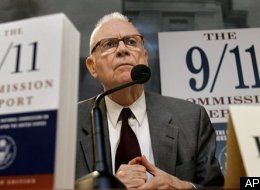
The pervasive news surrounding the confirmation hearing of John Brennan, Obama’s nominee for CIA director, is paralleled by another, related story that has been largely ignored by the U.S. media.  That is the story of the man called Abu Zubaydah, whose alleged torture testimony, obtained by the CIA while Brennan was the head of the agency’s Terrorist Threat Center, built the foundation for the official account of 9/11.  This week I spoke to Lee Hamilton, former vice-chairman of the 9/11 Commission, about the serious problems that the government’s new stance on Zubaydah creates for the 9/11 Commission Report.

As stated in my last article on the subject, Zubaydah is at the center of an unraveling of the official account of the 9/11 attacks.[1]  His extensive torture at the hands of the CIA during Brennan’s tenure, which included at least 83 water-boarding sessions, hanging the man naked from the ceiling, slamming him against a concrete wall, and other atrocious experimental techniques, was said to produce valuable evidence about al Qaeda.  However, the government now claims that Zubaydah was never a member or associate of al Qaeda and therefore he could not have known any of the information that the 9/11 Commission attributed to him.

From the start of our conversation, Hamilton told me that he was having trouble remembering Zubaydah.  That was odd considering that an article he and Thomas Kean wrote for the New York Times in 2008, describing how the CIA obstructed the 9/11 investigation, referred several times to Zubaydah specifically.[2]  The article claimed that “Beginning in June 2003, we requested all reports of intelligence information on these broad topics that had been gleaned from the interrogations of 118 named individuals, including both Abu Zubaydah and Abd al Rahim al-Nashiri, two senior Qaeda operatives.”  Kean and Hamilton further wrote that, “in October 2003, we sent another wave of questions to the C.I.A.’s general counsel. One set posed dozens of specific questions about the reports, including those about Abu Zubaydah.”

These requests from the 9/11 Commission should have resulted in the release of some revealing records.  That is, while John Brennan was leading the CIA’s Terrorist Threat Center, the agency videotaped the torture of Zubaydah and others, and proceeded to intentionally withhold that information from the 9/11 Commission.  Brennan and CIA director George Tenet were almost certainly involved in the decisions regarding that obstruction.  The two men had worked closely together for years.  As CIA station chief in Saudi Arabia, Brennan often communicated directly with Tenet, avoiding the usual chain of command.  At the time, as an apparent favor to the Saudis, CIA analysts were discouraged from questioning Saudi relationship to Arab extremists.[3]  It seems that Brennan and Tenet had a tendency to protect some terrorist suspects and cover-up the agency’s treatment of others.

It was revealed that when Brennan was the director of the National Counterterrorism Center, in 2005, the CIA had destroyed the torture tapes, most of which featured Zubaydah.[4]  Describing the CIA’s obstruction, Hamilton wrote — “The agency did not disclose that any interrogations had ever been recorded or that it had held any further relevant information, in any form. Not satisfied with this response, we decided that we needed to question the detainees directly, including Abu Zubaydah and a few other key captives.”[5]

Therefore Hamilton remembered very clearly, in 2008, that he had asked the CIA at least twice, in a potentially contentious manner, for information specifically about Zubaydah.  Having not received that information, Hamilton asked the CIA for the opportunity to question Zubaydah directly.  The CIA not only denied these requests, it denied the Commission access to the interrogators who compelled the alleged testimony.  Despite such memorable denials, however, Hamilton cannot seem to recall anything about Zubaydah at all other than his feeling that Zubaydah did not play a significant part in the 9/11 Commission Report.  He told me “I’m a little fuzzy on this but the information that we had from him was not critical to our report.”[6]

LEE-HAMILTON-largeReasons for Hamilton’s new, unconvincing amnesia on the subject might include that the U.S. government recently backed off its claims about this “detainee,” who has been imprisoned by the U.S. for eleven years without charges.  The retractions about Zubaydah create a tension with the 9/11 Commission Report that reveals an obvious need to revise the report.

For example, in response to the habeas corpus petition filed by Zubaydah’s defense team, the government stated that it does not contend that Zubaydah had “any direct role in or advance knowledge of the terrorist attacks of September 11, 2001.”[7]  The same response states that the government no longer claims that Zubaydah was ever “a member of al-Qaida or otherwise formally identified with al-Qaida.”  But footnote 35 to Chapter 5 of the 9/11 Commission Report states the exact opposite.  According to this footnote, “Abu Zubaydah, who worked closely with the al Qaeda leadership, has stated that KSM originally presented Bin Ladin with a scaled-down version of the 9/11 plan, and that Bin Ladin urged KSM to expand the operation with the comment, ‘Why do you use an axe when you can use a bulldozer?’”[8]  That’s pretty extensive and intimate knowledge for someone who was never associated with al Qaeda.

In our talk, I reminded Hamilton that Zubaydah was mentioned over 50 times in the 9/11 Commission Report, and that his alleged torture testimony, along with that of KSM and Ramsi bin Alshibh (both of whom Zubaydah identified as being involved in the attacks), produced the foundation of the official account of 9/11.  Creating the background for the official myth about al Qaeda, Hamilton’s report called Zubaydah an “Al Qaeda associate,” a “long-time ally of Bin Ladin,” a “Bin Ladin lieutenant,” and an “al Qaeda lieutenant.”[9]  Despite these important references, Hamilton told me that he just couldn’t remember Zubaydah, saying “my recollection is really quite vague with regard to him.”

To refresh his memory further, I reminded Hamilton that nine separate dates of Zubaydah’s interrogation were referenced in his report.  After these reminders, Hamilton said that he still had to “stretch his imagination to remember” him.  It seems that if Hamilton had read my article on Zubaydah, which I had sent to him over a week before he agreed to meet and eleven days before we talked, his memory would have returned easily.  Instead, Hamilton’s inability to stretch his imagination on the subject was reminiscent of the “failure of imagination” excuse used by the 9/11 Commission when it proposed an overall explanation for the events of 9/11.

Because the government no longer contends that Zubaydah was in any way associated with al Qaeda and now says that he had no knowledge of the 9/11 attacks, I asked Hamilton if he had an opinion on how Zubaydah could have known so much about al Qaeda as stated in his report.  Bluntly stating “No,” Hamilton suggested that he was not concerned with these contradictions.

Our discussion went into the recent conviction of John Kiriakou, the CIA’s Chief of Counterterrorist Operations in Pakistan after 9/11, who was originally said to be responsible for the capture and initial interrogations of Zubaydah.  Interestingly, Kiriakou’s story has evolved much like that of the official account concerning Zubaydah.  According to people who would know, with regard to Zubaydah “Kiriakou now rather off handedly admits that he basically made it all up.”[10]

Kiriakou has since been heralded as a whistleblower.  And he recently said that, for embracing torture, John Brennan is a terrible choice to lead the CIA.  Kiriakou claimed that he has known Brennan since 1990 and has worked for him twice.  While in the CIA, Kiriakou noted, Brennan “would have had to have been intimately involved in—not necessarily in carrying out the torture techniques, but in the policy, the torture policy.”[11]  It is true that this would seem to make Brennan an especially poor choice but today it is clear that those who engaged in torture, and those who used alleged torture testimony to create false reports, will not be held accountable.

This week I also spoke to Brent Mickum, Zubaydah’s attorney.  Unlike Hamilton, Mickum was very straightforward and convincing.  The information he possesses suggests that Zubaydah was a victim of false claims from the beginning.  Mickum believes there may be alternative reasons why his client, who does not support the murder of innocents or suicide attacks and who repeatedly refused to join al Qaeda, was chosen to become the first, experimental, torture victim.  Mickum expects Zubaydah to be charged sometime this year but cannot say what the charges will be.  The evidence no longer supports claims that Zubaydah conspired with al Qaeda in any way.  Additionally, he cannot be charged as an enemy combatant through the 2006 Military Commissions Act considering that he was captured and tortured years before that law was enacted.

With this in mind, I asked Lee Hamilton if Abu Zubaydah should be allowed to tell his own story now that his illegal detention and torture have proven to be based on falsehoods.  Hamilton said that he would not take a stand on the subject one way or another.  This refusal is yet another reason to suspect that Lee Hamilton will never come clean on the 9/11 Commission’s use of unreliable torture testimony.

Although Hamilton has repeatedly stated publicly that he believes torture is immoral and that the U.S. must take a strong stance against it, his actions and his work speak otherwise.  The glaring problem he faces now is that it is the 9/11 Commission Report that stands as the definitive argument supporting the use of torture.  After all, if not for the alleged torture testimony of Abu Zubaydah and the people he reportedly identified (KSM and Ramsi bin Alshibh in particular) Hamilton’s report would have little evidentiary basis.  Consequently, as the U.S. government strains to come up with charges to apply to Zubaydah after disclaiming his connections to al Qaeda, the Commission’s report remains at risk of being further challenged by whatever charges are ultimately filed.


[1] Kevin R. Ryan, Abu Zubaydah Poses a Real Threat to Al Qaeda, Dig Within, October 15, 2012, https://digwithin.net/2012/10/15/zubaydah/

[2] Thomas H. Kean and Lee H. Hamilton, Stonewalled by the C.I.A., The New York Times, January 2, 2008, http://www.nytimes.com/2008/01/02/opinion/02kean.html?_r=0

[3] James Risen, State of War: The Secret History of the CIA and the Bush Administration, Free Press, 2006

[4] Mark Mazetti, .U.S. Says C.I.A. Destroyed 92 Tapes of Interrogations, The New York Times, March 2, 2009, http://www.nytimes.com/2009/03/03/washington/03web-intel.html?_r=0

[5] Thomas H. Kean and Lee H. Hamilton, Stonewalled by the C.I.A

[6] Notes from my talk with Lee Hamilton, February 7, 2013

[7] Zayn al Abidin Muhammad Husayn v. Robert Gates, Respondents Memorandum of Points and Authorities in Opposition to Petitioner’s Motion for Discover and Petitioner’s Motion for Sanctions. Civil Action No. 08-cv-1360 (RWR), September 2009

[8] See the footnote 35 to Chapter 5 of the 9/11 Commission Report, which sources the information from “Intelligence report, interrogation of Abu Zubaydah, May 16, 2003,” http://govinfo.library.unt.edu/911/report/911Report_Notes.htm

[9] National Commission on Terrorist  Attacks Upon the United States, The 9/11 Commission Report, www.9-11commission.gov/report/911Report.pdf

[10] Jeff Stein, Foreign Policy, CIA Man Retracts Claim on Waterboarding, January 6, 2010

[11] Democracy Now, Whistleblower John Kiriakou: For Embracing Torture, John Brennan a “Terrible Choice to Lead the CIA”, January 30, 2013, http://www.democracynow.org/2013/1/30/whistleblower_john_kiriakou_for_embracing_torture

Posted in 9/11 | 15 Comments